Proposed National Security Bill Threatens Fundamental Rights and Democratic Oversight – ILRAJ Warns
 Deborah Sorie
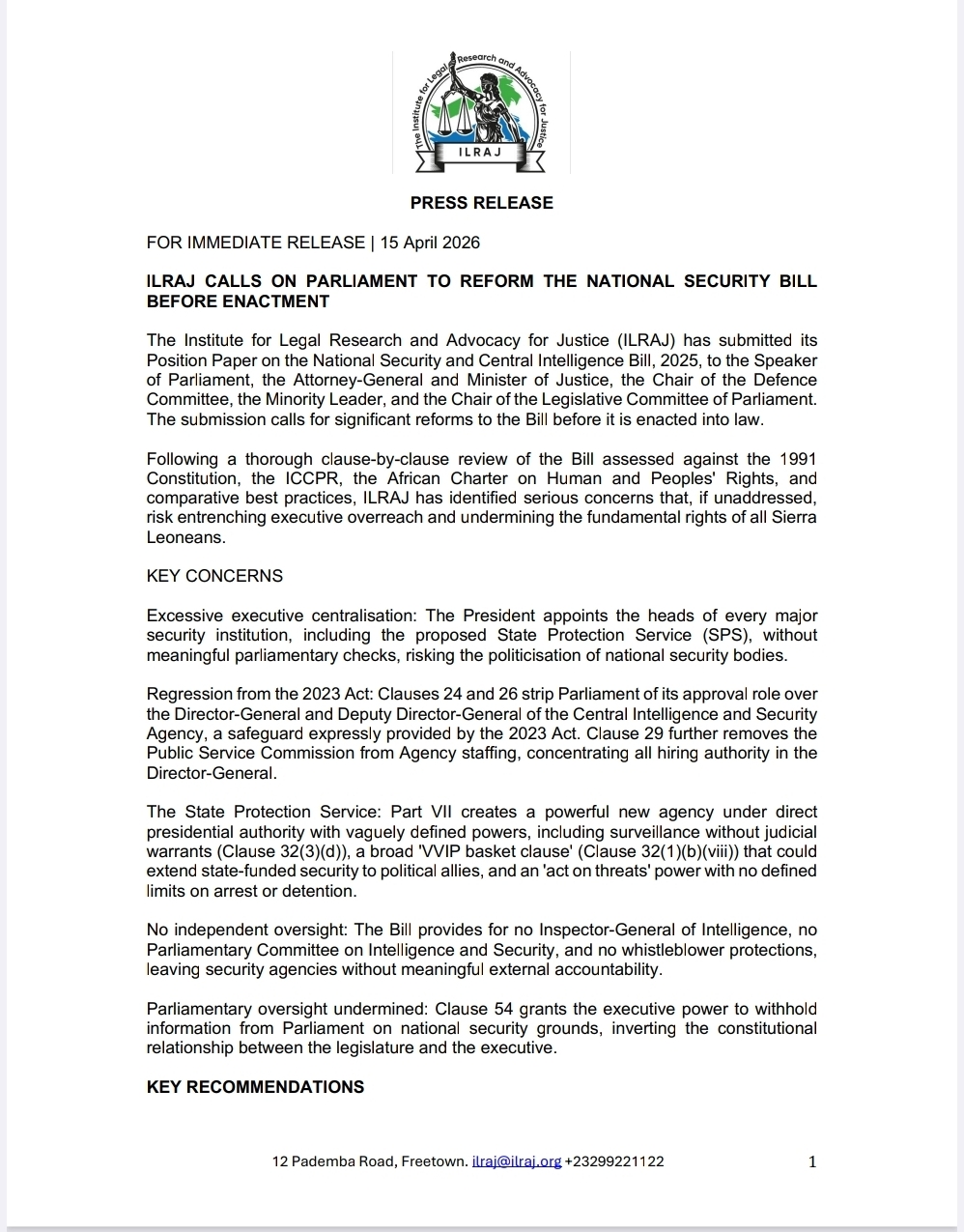
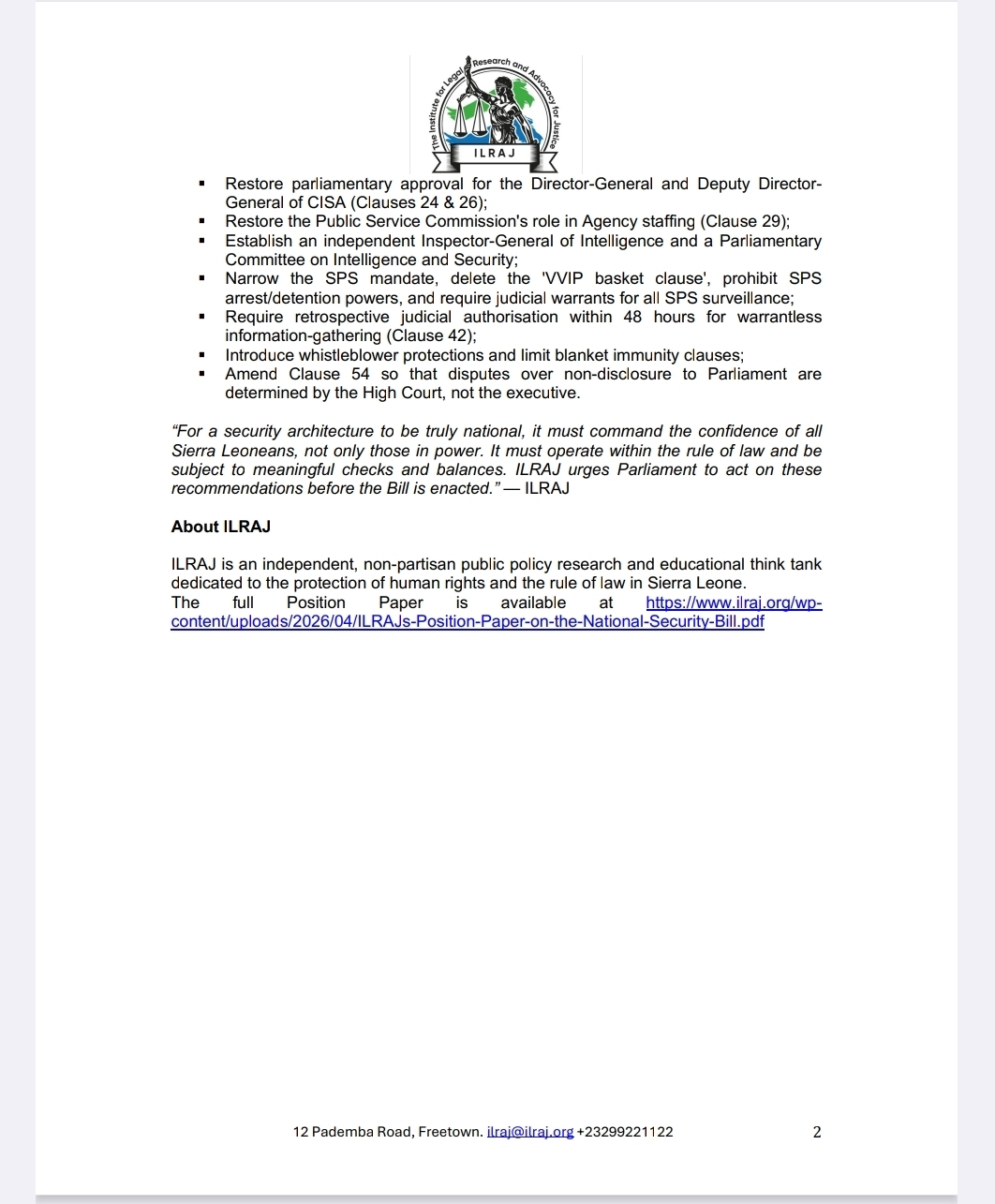
 The Institute for Legal Research and Advocacy for Justice (ILRAJ) has called on Sierra Leone’s Parliament to significantly reform the National Security and Central Intelligence Bill, 2025 before it becomes law, warning that key provisions could entrench executive overreach and undermine fundamental rights.
In a position paper submitted to the Speaker of Parliament, the Attorney-General, and other senior officials, ILRAJ said its clause‑by‑clause review—benchmarked against the 1991 Constitution, the ICCPR, and the African Charter on Human and Peoples’ Rights—had revealed serious gaps in accountability and oversight.
Among the main concerns, ILRAJ said the Bill centralises excessive power in the presidency by allowing the president to appoint heads of major security bodies, including the proposed State Protection Service (SPS), without meaningful parliamentary checks.

The organisation also pointed to a regression from the 2023 Act: Clauses 24 and 26 would strip Parliament of its approval role over the Director‑General and Deputy Director‑General of the Central Intelligence and Security Agency (CISA), while Clause 29 would remove the Public Service Commission from agency staffing, concentrating hiring authority in the Director‑General.

Mighty Blackpool Raises Concerns Over Handling of Late Midfielder Bureh Ganso Koroma’s Injury and Treatment
President Bio to Serve as Keynote Speaker at the International Forum on African-Caribbean Leadership in New York

Car Wash Boy Arrested in Freetown for ‘Stealing’ Laptop, Other Valuables From Client’s Vehicle
ILRAJ further criticised the creation of the State Protection Service under Part VII, describing it as a powerful new agency placed directly under presidential authority. It noted that the SPS would have vaguely defined powers, including surveillance without judicial warrants, a broad “VVIP basket clause” that could extend state‑funded security to political allies, and an “act on threats” power with no defined limits on arrest or detention.
The absence of independent oversight is another major flaw, ILRAJ said, noting that the Bill provides for no Inspector‑General of Intelligence, no Parliamentary Committee on Intelligence and Security, and no whistleblower protections. It added that Clause 54 would allow the executive to withhold information from Parliament on national security grounds, inverting the constitutional relationship between the legislature and the executive.
To remedy these issues, ILRAJ recommended restoring parliamentary approval for CISA’s top leadership, reinstating the Public Service Commission’s role in staffing, establishing an independent Inspector‑General of Intelligence and a parliamentary oversight committee, narrowing the SPS’s mandate, requiring judicial warrants for surveillance, and introducing whistleblower protections.
“For a security architecture to be truly national, it must command the confidence of all Sierra Leoneans, not only those in power,” ILRAJ said. “It must operate within the rule of law and be subject to meaningful checks and balances.”