

President Bio Launches Construction of Sierra Leone’s First Industrial Fishing Port
 Daniel Amara
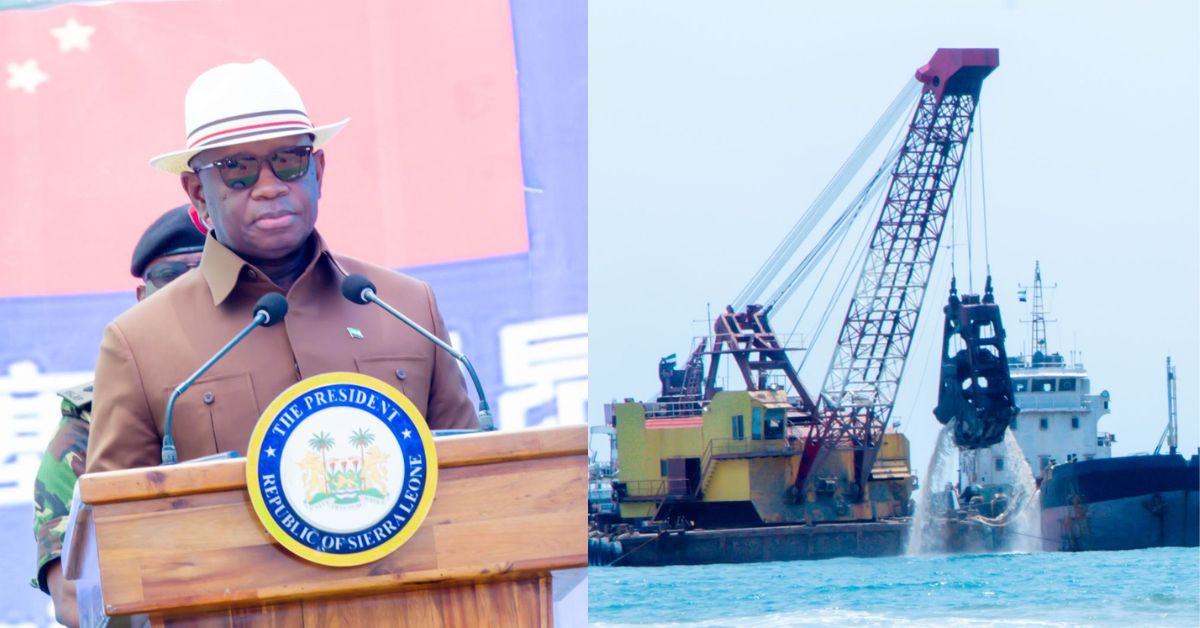
 Sierra Leone has taken a major step toward transforming its fisheries sector, as President Julius Maada Bio officially broke ground for the country’s first industrial fishing port at Black Johnson.
The landmark project, named the Julius Maada Bio Industrial Fishing Port, is being positioned as a cornerstone of Sierra Leone’s drive to develop its Blue Economy and maximize the benefits of its marine resources.
In his keynote address, President Bio emphasized that Sierra Leone’s identity as a maritime nation has long been undermined by the absence of critical infrastructure. Despite having over 570 kilometres of coastline and rich marine biodiversity, the country has struggled to fully utilize its estimated 450,000 metric tons of sustainable fish stock annually.

He noted that weak systems for harvesting, preservation, and processing have historically limited the sector’s growth, allowing foreign fleets to dominate and extract value from local waters.

“This is not a failure of effort, but a failure of infrastructure, investment, and national prioritisation. Today, we begin to correct it,” the President stated.
The planned port will serve as a comprehensive fisheries hub, providing facilities for vessel berthing, unloading, refuelling, maintenance, and fish processing. It will also support transshipment and distribution to both domestic and international markets.
Officials say the port will align with global fisheries governance frameworks, including standards under the United Nations Convention on the Law of the Sea, strengthening Sierra Leone’s regulatory capacity and international competitiveness.
President Bio also reflected on his earlier involvement in the fisheries sector, recalling his role in advancing maritime governance during his tenure as Minister of Fisheries and Marine Resources in the 1990s.
The project is being financed through a $55 million grant from China, with President Bio expressing gratitude to President Xi Jinping and the Chinese government for their support.
“This partnership is responsive, respectful, and results-driven,” he said, highlighting the importance of international cooperation in achieving national development goals.
Authorities expect the industrial fishing port to significantly boost fisheries productivity, reduce post-harvest losses, create employment opportunities, and increase export revenues.
Once completed, the facility is anticipated to strengthen Sierra Leone’s position in the global fisheries value chain and contribute to long-term economic growth.
The Black Johnson project marks a pivotal moment in the country’s efforts to harness its ocean resources and build a more resilient and inclusive economy.