

 Post a comment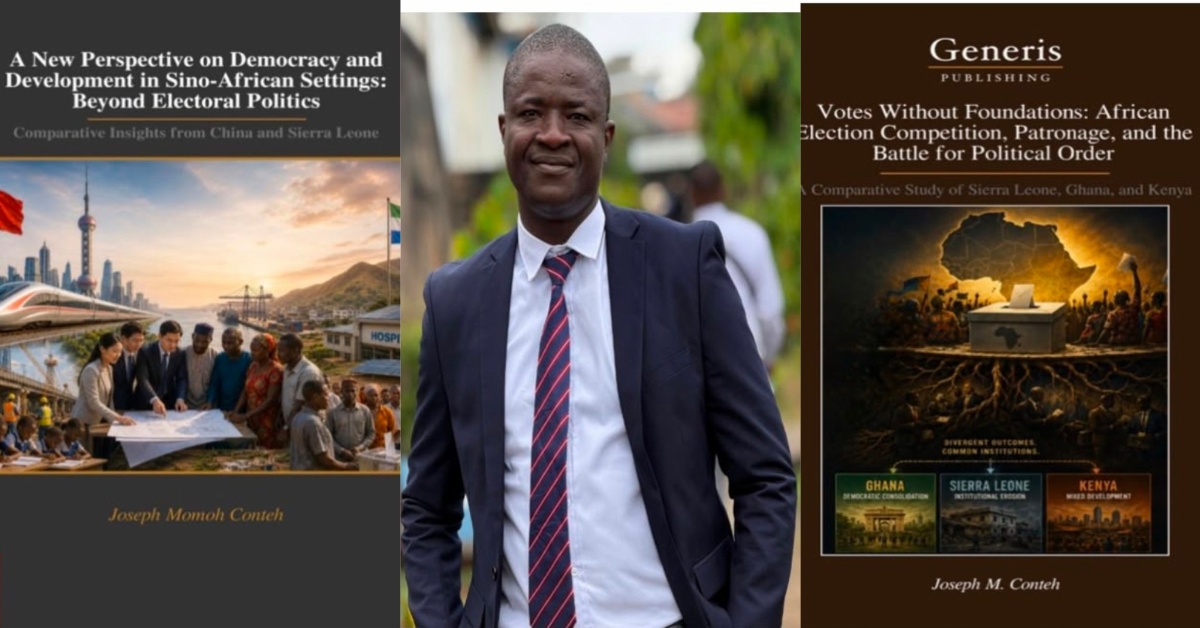
Two new scholarly works by Sierra Leonean academic Joseph Momoh Conteh are sparking debate on the relationship between democracy and development in Africa, challenging long-held assumptions about elections as the primary pathway to progress.
Conteh, a development practitioner and ICT specialist, argues that while many African countries, including Sierra Leone, have consistently held elections since independence, this has not necessarily translated into significant improvements in living standards.
“Sierra Leone has held credible elections since 1961. It sits 148th on the Human Development Index. The gap between voting and living well has never been more urgent to explain,” Conteh notes.
He contrasts this with China, which, despite operating a one-party political system without competitive multiparty elections, has lifted hundreds of millions of people out of poverty over recent decades — a comparison he uses to question conventional development narratives.
Exploring the “Legitimacy Gap”
Conteh’s first book, A New Perspective on Democracy and Development in Sino-African Settings: Beyond Electoral Politics, developed from his doctoral research at Peking University’s Institute of South-South Cooperation and Development, introduces what he describes as the “legitimacy gap.”
The concept distinguishes between procedural legitimacy — derived from elections — and performance legitimacy, which is earned through effective governance and tangible improvements in citizens’ lives.
Across twelve chapters, the book examines infrastructure, education, health, and digital governance, seeking to explain why countries with similar democratic systems have experienced vastly different development outcomes.
Conteh stresses that his work is not an endorsement of authoritarian governance, but rather an analysis of state capacity and institutional effectiveness. He calls for stronger institutions, improved governance systems, and a political culture that prioritises delivery and accountability.
He also examines China’s development engagement with Africa through frameworks such as the Forum on China–Africa Cooperation (FOCAC) and the Belt and Road Initiative, highlighting both opportunities and risks.
Why Elections Deliver Differently in Africa
His second book, Votes Without Foundations: African Election Competition, Patronage, and the Battle for Political Order, compares Sierra Leone, Ghana, and Kenya to explain why elections produce different governance outcomes across Africa.
While Ghana is presented as a case of democratic consolidation, Sierra Leone is described as experiencing institutional fragility despite regular elections, and Kenya as reflecting partial consolidation alongside ethnic-based political competition.
Using data from Afrobarometer surveys, governance indicators, and the Pedersen index of electoral volatility, Conteh develops a “conditional theory” of democracy. It argues that electoral outcomes depend heavily on underlying political and institutional structures, including patronage systems, party institutionalisation, and governance coherence.
He concludes that elections alone are insufficient to guarantee democratic stability.
“Elections strengthen or unsettle political order depending on the institutional foundations beneath them. Without those foundations, the ballot box is not a pillar of democracy — it is a stage,” he writes.
A Scholar Bridging Theory and Practice
Beyond academia, Conteh serves as Director of Administrative and ICT Specialist at Sierra Leone’s Justice Sector Coordination Office (JSCO) under the Ministry of Justice, where he has been involved in institutional reform efforts.
He holds advanced degrees from institutions in China and India and is currently pursuing doctoral research at Peking University.
According to him, his objective is to bridge the gap between policy and practice by offering practical frameworks for long-term national development.
Why the Books Matter
The release of the books comes at a time when African democracies continue to face questions about governance, development, and public trust in political systems.
While multiparty elections have become widespread since the 1990s, critics argue that many states still struggle to translate electoral democracy into socioeconomic transformation.
Conteh’s works add to this debate by urging policymakers and citizens to rethink what governance should achieve beyond the ballot box.
“These are not books for the comfortable,” the narrative suggests. “They are for those willing to ask difficult questions about why development continues to lag behind democracy.”
Availability
A New Perspective on Democracy and Development in Sino-African Settings is available in softcover and e-book formats on Amazon, Generis Publishing, Libroterra, and Bookfinder (ISBN: 979-8-89966-614-8).
Votes Without Foundations is available through Generis Publishing and Libroterra.


