

Sierra Leone Governement Needs Additional US$42.5 Million to Support Electricity Supply
 Tolulope Aina
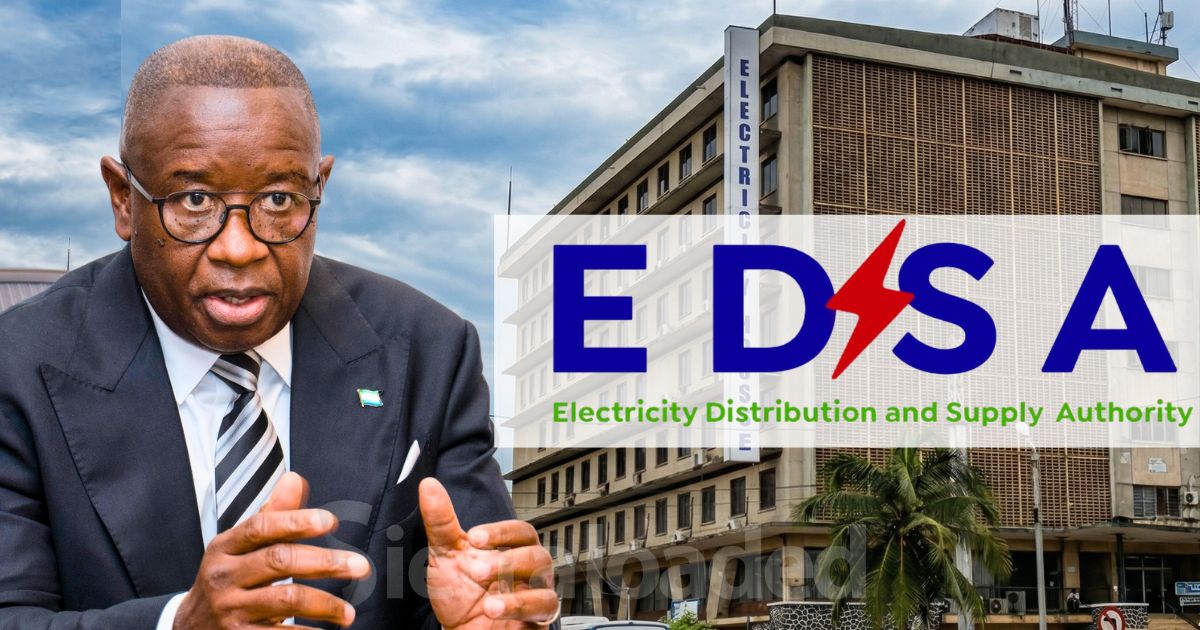
 The International Monetary Fund (IMF) says the Government of Sierra Leone is expected to provide an additional US$42.5 million this year to help keep electricity flowing across the country, highlighting the growing financial challenges facing the nation’s power sector despite ongoing reforms.
Sierraloaded understands that the additional funding will enable the Electricity Distribution and Supply Authority (EDSA) to meet its payment obligations to Independent Power Producers (IPPs), which generate a significant portion of Sierra Leone’s electricity.
According to the IMF, the increased transfers have become necessary as the government seeks to avoid disruptions in electricity supply while implementing broader fiscal reforms under its Extended Credit Facility (ECF) programme.

In its latest Country Report on Sierra Leone, the IMF noted that although the government has made significant progress in restoring macroeconomic stability through tighter fiscal and monetary policies, mounting pressures in the energy sector continue to pose one of the country’s biggest fiscal risks.


“To ensure continuity of electricity supply, the authorities expect to have to transfer US$42.5 million more than previously envisaged to help the electricity utility (EDSA) meet its obligations to Independent Power Producers (IPPs),” the IMF stated.
The expected increase in government support comes as Sierra Leone continues to grapple with high electricity generation costs, technical losses within the distribution network and revenue collection challenges that have strained the financial position of the state-owned utility.
The IMF identified the electricity sector as one of the most significant sources of fiscal pressure on the government.
While government have undertaken ambitious fiscal consolidation measures since 2022, the report noted that financial weaknesses within EDSA continue to require substantial government intervention to sustain electricity supply.
According to the Fund, EDSA’s sizeable arrears to Independent Power Producers, combined with technical and commercial losses on the electricity network and weak revenue collection, continue to place considerable pressure on public finances.
“The Electricity Distribution and Supply Authority (EDSA)’s sizeable arrears with IPPs, significant technical losses, and poor revenue collection constitute substantial fiscal risks,” the report stated.
The IMF disclosed that arrears owed by EDSA were estimated at US$113 million as of the end of February 2026. Those liabilities are being monitored monthly by the Ministry of Finance’s Fiscal Risk Unit because of their potential impact on government finances.
Despite the additional financial burden, the IMF acknowledged that maintaining electricity supply remains essential for households, businesses and public institutions.
Sierra Leone has expanded electricity access in recent years through increased reliance on Independent Power Producers, whose contracts require regular payments for electricity generated and supplied to the national grid.
Failure to honour these obligations could lead to reduced electricity generation, threatening power supply in Freetown and other urban centres where businesses, hospitals, schools and government institutions rely heavily on grid electricity.
The IMF noted that ensuring uninterrupted electricity supply has become even more important as Sierra Leone seeks to support economic growth through agriculture, manufacturing and services.
While recognising the immediate need for additional government funding, the IMF stressed that the long-term solution lies in accelerating reforms across the electricity sector.
The report said the government has committed to implementing World Bank-supported reforms designed to improve the operational and financial performance of EDSA.
Among the planned measures is the selection of a private concessionaire to operate and maintain the electricity distribution network, with government expected to move quickly to operationalise the concession once it is awarded.
According to the IMF, these reforms are expected to improve revenue collection, reduce technical and commercial losses and strengthen operational efficiency across the power sector.
The report projects that government transfers to Independent Power Producers will gradually decline from about US$62.5 million in 2026 to around US$20 million by 2030 as reforms take effect and lower-cost electricity generation replaces expensive diesel-powered plants.
The IMF said future investments in solar energy projects, including Solar Planet and Respite, together with planned gas-powered generation and support from the Millennium Challenge Corporation for the Southern Transmission Corridor, are expected to lower electricity production costs over the medium term.