

Sierra Leone Has Africa’s Most Expensive Residential Electricity Tariff, Data Shows
 Sorie Abubakar
 Sierra Leone has emerged as the country with the most expensive residential electricity tariff among the African markets assessed by energy data firm Electron Intelligence, depicting the growing cost of power for households in a country where many families already struggle with rising living expenses.
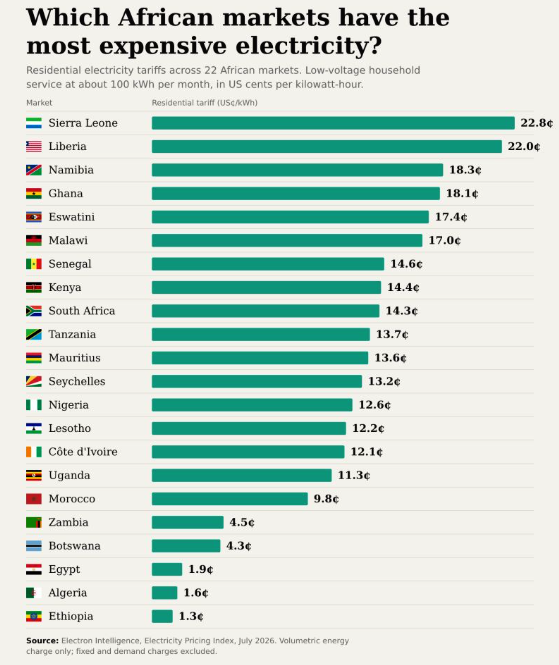
According to the latest Electron Intelligence comparison, Sierra Leone’s residential electricity tariff stands at 22.8 US cents per kilowatt-hour (kWh), placing the country at the top of a comparison of 22 African electricity markets. The figures compare the volumetric charge for a low-voltage residential consumption band of 100 kWh per month and are converted into US cents using average annual or year-to-date exchange rates.
The data put Sierra Leone ahead of neighbouring Liberia, where the residential tariff is about 22 US cents per kWh. At the opposite end of the ranking is Ethiopia, where consumers pay approximately 1.3 US cents per kWh. The continental median is about 13.4 US cents per kWh, meaning Sierra Leone’s reported rate is substantially above the African average in the comparison.


In local currency, a rate of about Le4.7 per kWh means that a household consuming 50 kWh, equivalent to 50 units, could spend roughly Le 235 on electricity consumption alone, before any applicable fixed charges or other costs.
For households on low and irregular incomes, the rising cost of electricity represents more than an increase in a monthly bill. It can force families to reduce consumption, switch off essential appliances, or divert money that would otherwise be used for food, education, transportation and other necessities.
Why is electricity so expensive?
Electron Intelligence cautions that electricity prices across Africa are shaped by several factors, including the size of national grids, fuel sources, subsidies and the cost of delivering power. Its analysis notes that smaller power systems can face higher costs per unit because of limited grid scale and expensive generation.
Sierra Leone’s electricity sector has also faced persistent financial and operational challenges. In July 2026, the International Monetary Fund (IMF) reported that the government was expected to provide an additional US$42.5 million to support electricity supply and enable the Electricity Distribution and Supply Authority (EDSA) to meet obligations to independent power producers.
The pressure on consumers is therefore occurring alongside pressure on the state and the power utility itself. The government has been pursuing reforms aimed at improving revenue collection, reducing losses and making the sector more financially sustainable. The IMF has also noted that Sierra Leone’s revised regulatory framework enables cost-reflective electricity tariffs, while warning that tariff adjustments can create resistance among consumers.
The history of prepaid metres in Sierra Leone
Sierra Leone’s shift towards prepaid electricity metring was part of broader efforts to address revenue collection and improve the financial sustainability of the electricity sector. The system was first introduced under the President Ernest Bai Koroma administration
A major expansion of prepaid metering took place in 2019, when a large number of postpaid metres were replaced with prepaid metres. Sierra Leone’s national development reporting says the change contributed to an improvement in electricity revenue collection, which reached about 85 percent nationwide in 2019.
The prepaid-metre programme was subsequently expanded through partnerships involving the Government, the Ministry of Energy and EDSA. A major vendor-financing project began in April 2019, under which prepaid smart metres were supplied and installed across the country. The project records show that tens of thousands of single- and three-phase prepaid metres were supplied.
The system changed the relationship between consumers and the electricity provider. Instead of receiving a bill after consuming electricity, customers purchase credit in advance and load tokens onto their meters. The arrangement was intended to strengthen payment discipline, reduce unpaid bills and improve revenue collection.
The technology itself has also evolved. In August 2024, EDSA began a nationwide upgrade of prepaid meters from Standard Transfer Specification (STS) Edition One to STS Edition Two, requiring consumers to update their meters with new tokens. The upgrade was necessary because the older system was approaching the end of its operational life.
While prepaid metering has helped the electricity authority collect revenue more directly, it has also made the impact of tariff increases much more immediate for consumers.
Under a prepaid system, a household cannot simply wait for a monthly bill. When the credit runs out, the electricity supply stops until more credit is purchased. As tariffs rise, the same amount of money buys fewer units, leaving consumers with a stark choice between spending more or using less electricity.
Official tariff records show how hefty the charges can be. The Sierra Leone Electricity and Water Regulatory Commission’s approved 2024 tariff, for example, placed ordinary residential consumption of up to 200 kWh at NLe4,853 per kWh, including GST, while higher-end residential consumption above 200 kWh was charged at NLe5,271 per kWh.
The regulator has repeatedly approved revised tariff structures, including a tariff structure that took effect in October 2023.
This creates a difficult contradiction for consumers: the country is trying to improve electricity access and the financial sustainability of its power sector, yet the cost of consuming electricity is becoming increasingly difficult for ordinary households to absorb.
Sierra Leone still faces substantial energy-access challenges. A recent World Bank energy-access assessment found that roughly two-thirds of the population live in areas without grid availability, while only about one-third of the population live in areas with grid infrastructure and are actually connected. High upfront connection costs were identified as a major barrier.
As the country seeks to expand generation, strengthen the grid and attract investment, the challenge will be ensuring that improvements in the power sector do not come at a cost that places electricity beyond the reach of ordinary Sierra Leoneans.
The latest tariff ranking has therefore renewed a broader question about Sierra Leone’s electricity policy: how can the country build a financially sustainable power sector while keeping electricity affordable for a population already facing significant economic pressure?
For consumers, the answer matters every time they buy a prepaid token because in a prepaid system, the cost of electricity is felt immediately, unit by unit.