

 Post a comment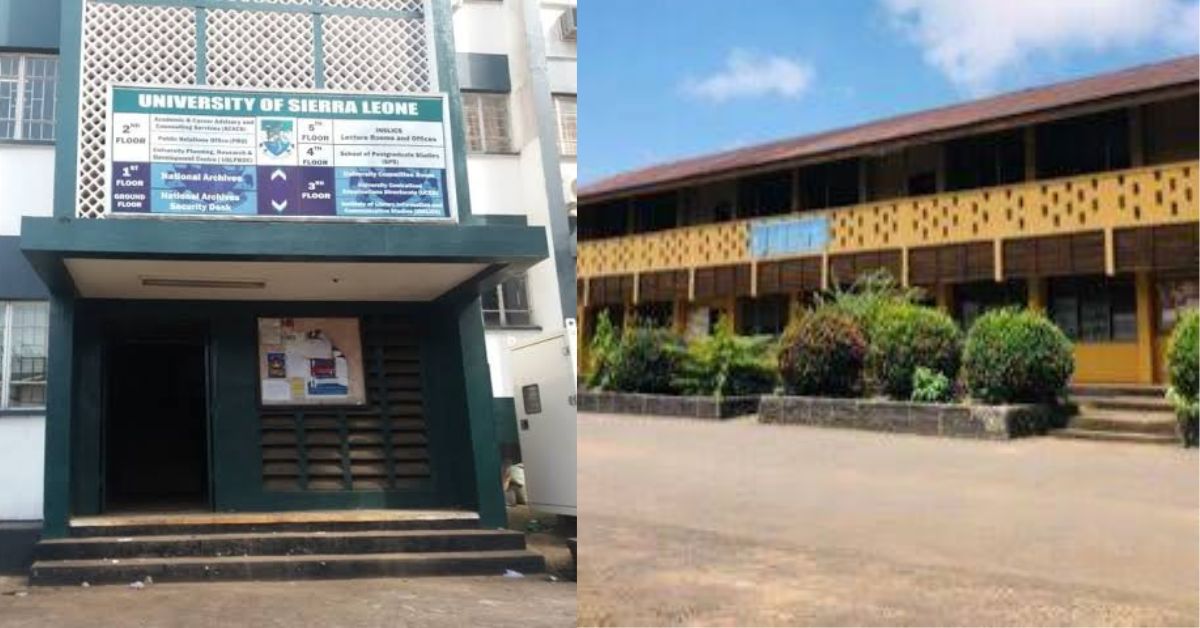
Students at the University of Sierra Leone (USL) and the Milton Margai Technical University (MMTU) have raised strong concerns over what they describe as persistent annual increases in tuition and other charges, saying the rising costs are unfair and unsustainable amid the country’s current economic challenges.
As the 2025/2026 academic year begins, many students say the new fee structure continues a pattern seen over the past five years, with each academic year bringing higher charges than the last.
The situation, they argue, marks a sharp shift from the period before 2018 when government-owned institutions operated under a 50 percent subsidy scheme that made higher education more affordable.
Under the current fees for the 2025/2026 academic year, first-year students at USL are required to pay NLe10,208. Of this amount, tuition accounts for NLe5,820, with the remaining balance made up of various administrative and service charges. Law students pay the highest fees among the faculties, with first-year costs rising to NLe13,792, up from NLe11,116 last year.
At USL’s constituent colleges-Fourah Bay College (FBC), the Institute of Public Administration and Management (IPAM), and the College of Medicine and Allied Health Sciences (COMAHS)-pharmacy students face the highest fees, with first-year costs reaching NLe16,841.
Fee increases are also affecting continuing students. At the Mass Communication faculty, final-year students who paid NLe6,185 in their first year now pay NLe7,108. Postgraduate students are facing even steeper hikes. Master’s students in Mass Communication have seen their fees double from NLe26,450 in the previous academic year to NLe52,000 for 2025/2026.
Despite the widespread complaints as reported by Truth Media, the University of Sierra Leone has denied increasing fees. Dr. Tonya Musa, Director of Communications and Public Relations at USL, said the administration has not raised any charges.
However, a former Director of Communications at Fourah Bay College, James Tamba Lebbie, previously explained that fee adjustments are linked to inflation. According to him, first-year fees are usually reviewed upward each year, while the fees of continuing students are expected to remain relatively stable.
Students across different institutions say their experiences do not reflect these explanations. Abubakarr Turay, a first-year Laboratory Science student at Milton Margai University, presented a receipt showing he paid NLe10,600 in tuition and related charges.
He compared this with what his classmate, Emmanuel Korfeh, paid the previous year. Korfeh said he paid NLe7,300 for his first year, a difference of NLe3,300. Korfeh, who is no longer enrolled, said the rising costs forced him to drop out. “I could no longer handle how expensive the fees have become,” he said.
At Fourah Bay College, Abubakarr Tarawally, a Peace and Conflict Studies student, described the situation as unbearable. “The increment is frustrating. As I speak, I am yet to clear my arrears,” he said.
Beyond the cost itself, students are also questioning the value of the services included in the fees. Mohamed Janneh, President of Students Against Corruption at Milton Margai University, said students are being charged for facilities and activities that are not provided. “We are not against fee increments, but against paying for facilities that are not rendered. Computer labs and field trips are included in the charges, but they never happen,” he said.
Similar concerns were raised by Ibrahim Sesay, a History student at Fourah Bay College. He said students were initially told that fees would reduce as they progressed to higher years because certain charges, such as orientation and matriculation, would no longer apply. “But instead, they keep increasing,” he said.
The government’s Student Grant-in-Aid scheme, which is intended to cover 50 percent of tuition for selected students, has also come under criticism. Beneficiaries say government payments are often delayed or fail to reach universities on time, resulting in students being treated as defaulters.
One grant recipient said students under the scheme are frequently sent out of examination halls along with those who have not paid any fees. “We are categorized the same way, even though the government is supposed to cover part of our costs,” the student said.
As complaints continue to grow, students say they are calling not only for transparency in fee setting, but also for accountability in how charges are applied and whether the promised services are actually delivered.


