

First Lady Fatima Bio Urges Global Action to End Child and Forced Marriage at UN Assembly
 Sahid Bangura
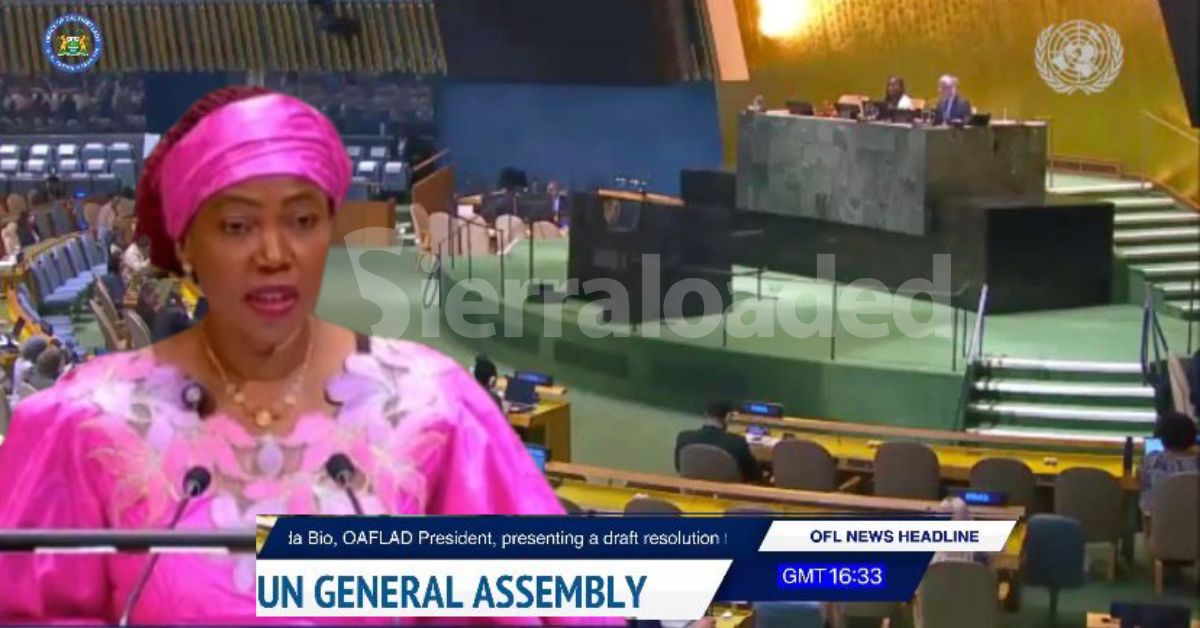
 First Lady of Sierra Leone and President of the Organisation of African First Ladies for Development (OAFLAD), Dr Fatima Maada Bio, has called for stronger global action to eliminate child, early and forced marriage, urging countries to protect girls’ rights to education, dignity and a future of their own choosing.
Addressing the United Nations General Assembly in New York on Friday, September 4, 2026, Dr. Fatima Bio introduced a draft resolution seeking to establish November 27 as the International Day for the Elimination of Child, Early and Forced Marriage.
She said Sierra Leone was leading the initiative as the main sponsor, with 65 Member States already supporting the resolution as co-sponsors.

According to the First Lady, establishing an international day would provide a platform for governments and other stakeholders to renew political commitments, strengthen advocacy, raise awareness, promote accountability and accelerate efforts to end child, early and forced marriage.
Intellectual Property Misuse: Statistics Sierra Leone Accused of Using Uncredited Logo in 2026 Census Launch
Minister of Internal Affairs Assesses Port Loko Correctional Centre After Fire Incident
Announcing Mid-Term Census Result Without Paying Staff Shows How Fraudulent And Unprofessional The Entire Process Was
“Your support sends a powerful message to girls everywhere: their rights, dignity and future are not negotiable,” she told delegates.
Dr. Fatima Bio urged Member States that had not yet joined the initiative to support the resolution, stressing that doing so would demonstrate a collective commitment to protecting girls from practices that deprive them of childhood and opportunities.
She highlighted the consequences of forced marriage, including the loss of education and economic opportunities, exposure to violence and abuse, and the perpetuation of intergenerational poverty.
The First Lady argued that ending child marriage should be viewed not only as a human rights obligation but also as an investment in human capital, families, economies and national development.
“We cannot speak credibly of gender equality while millions of girls are denied the right to determine the course of their own lives,” she said.
Dr. Fatima Bio also drew on her personal experience, saying her advocacy was informed by a journey she had experienced herself and survived.
“This is a journey I know from my own life-one I was fortunate to survive,” she said, adding that she was using her voice to represent the hopes of millions of children, particularly girls, who should be protected from similar experiences.
She said the proposed International Day would also create an annual opportunity to amplify the voices of survivors and girls, encourage stronger legislation and enforcement, increase investment in girls’ education and protection, and support communities in challenging harmful practices and norms.
However, Dr. Fatima Bio cautioned that establishing an international day alone would not end child marriage, stressing that sustained political will, effective institutions, strong laws, education, economic opportunities and community leadership were necessary to achieve lasting change.
“An International Day cannot, by itself, end child marriage. But political attention can. Strong laws can. Effective institutions can. Education can. Economic opportunities can. Community leadership can. And, above all, sustained political will can,” she said.
She cited Sierra Leone’s Prohibition of Child Marriage Act 2024 as evidence of the country’s commitment to strengthening legal protection for children, while acknowledging that legislation must be supported by effective enforcement, institutional capacity, community engagement and economic empowerment.
“Strong laws set standards. Strong institutions enforce them. Strong political leadership changes society,” she said.
The First Lady called on Member States to strengthen their legal and institutional frameworks to prevent and eliminate child, early and forced marriage and ensure that survivors and girls at risk have access to protection, justice, education, health services and economic opportunities.
She also acknowledged the contributions of Zambia and Canada in advancing UN General Assembly Resolution 79/158 on child, early and forced marriage, and praised Zambian President Hakainde Hichilema for his leadership in efforts to end the practice.
Dr. Fatima Bio further commended President Julius Maada Bio for placing the protection and empowerment of women and girls on Sierra Leone’s national agenda.
She described the proposed resolution as more than a national initiative, saying its success would depend on collective international commitment to ensuring that girls are able to remain in school, determine their futures and live free from forced marriage.