

Sierra Leone Showcases Feed Salone Agenda at High-Level China Agriculture Forum
 Aminata Koroma
 The Ministry of Agriculture and Food Security (MAFS) has reaffirmed its commitment to transforming Sierra Leone’s agricultural sector through digital innovation and climate-smart solutions at a high-level global dialogue in China.
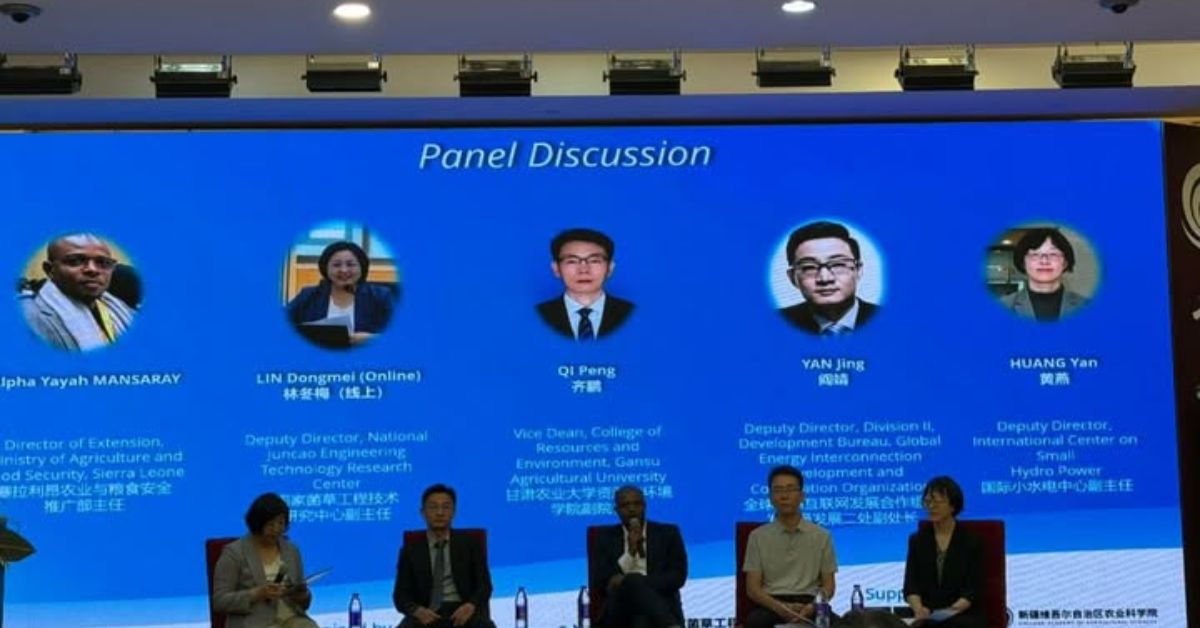
Representing the Ministry, the Director of Extension, Mr Alpha Yayah Mansaray, participated in the World Food Programme (WFP) China Centre of Excellence for Rural Transformation dialogue from June 2-5, where policymakers and development partners are engaging on green innovations for resilient food systems.
During a panel discussion, Mr Mansaray presented the Ministry’s flagship Feed Salone Agenda, positioning it as a comprehensive national strategy aimed at boosting productivity, enhancing food security, and building resilience against climate change.

He highlighted key Ministry-led interventions, including the digitalisation of agricultural input distribution through an E-Voucher System. The initiative, he noted, is designed to improve efficiency, ensure transparency, and guarantee that subsidised seeds and fertilisers reach intended beneficiaries.



“We subsidise the delivery of seeds and fertiliser through a system that promotes efficiency and transparency,” he stated.
The Ministry has also developed a national Farmers Registry-a geo-tagged database that supports evidence-based planning and targeted service delivery. This is reinforced by an Interactive Voice Response (IVR) system and a Call Center, enabling the Ministry to deliver real-time, localised advisory services to farmers across the country.
Mr Mansaray emphasised that these digital tools form part of MAFS’s broader strategy to modernise agriculture and strengthen farmer resilience.
“Under Feed Salone, we are using AgTech to make agriculture more productive, transparent, and climate-smart. These digital tools connect farmers directly to inputs, information, and decisions that build resilience,” he said.
The engagement also provided a platform for the Ministry to strengthen South-South cooperation and explore opportunities for scaling proven digital and green technologies across Africa.
Participants highlighted that sustainable agricultural transformation depends on integrating farmer data, digital payments, weather information, and advisory services to support informed decision-making. China’s “Digital + Green” model was cited as a practical example of how technology can be effectively adapted to local contexts.
Reaffirming the Ministry’s strategic direction, Mr. Mansaray noted that MAFS remains committed to building a robust digital backbone for the agricultural sector through partnerships and innovation.
“The Ministry, through the Extension Division, is ready to collaborate with partners to scale the e-voucher system, farmer registry, IVR, and weather data systems that make farming more efficient and climate-resilient,” he concluded.