

 Post a comment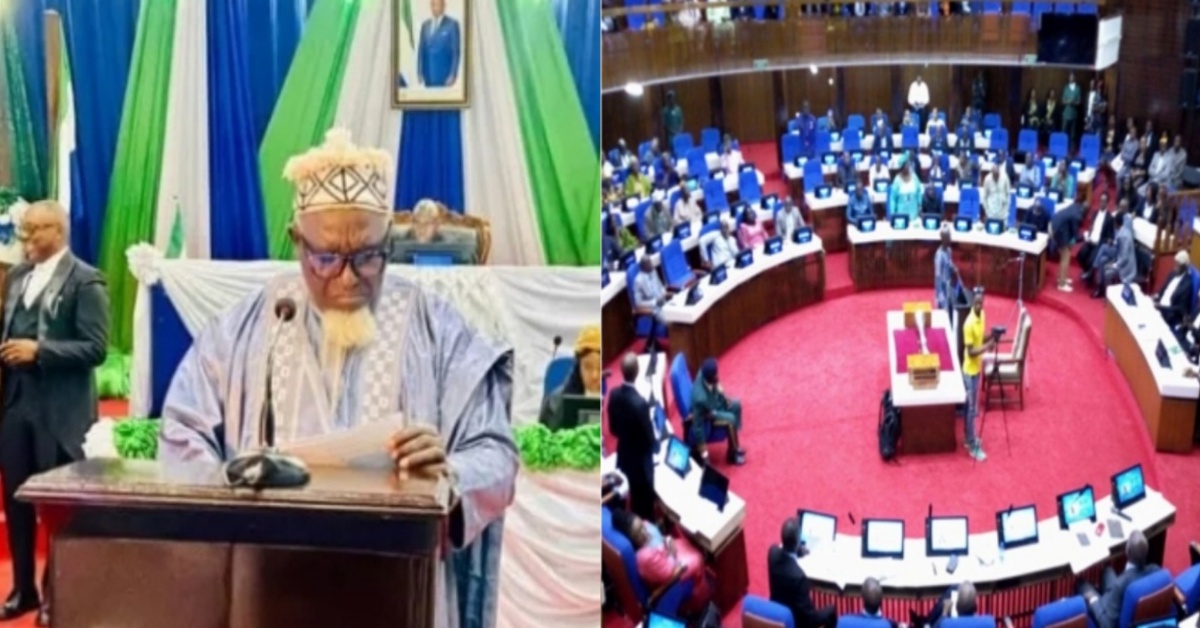
The Parliament of Sierra Leone is set to investigate serious concerns over land rights following the laying of a petition by Paramount Chief Member of Parliament, Hon. Alhaji Musa Bamba Foray Kulio Jalloh III, on Thursday, July 3, 2025.
The petition, which seeks to defend the rights of landowners and traditional authorities in Dansogoia, Sambaia, and Diang Chiefdoms in Tonkolili and Koinadugu Districts, has sparked a broader debate over customary land ownership and the powers of state agencies.
Speaker of Parliament and Chairman of the Public Petitions Committee, Rt. Hon. Segepoh Solomon Thomas, has announced that the committee will convene on Monday at 2:00 PM to address the petition.
He noted that the Committee may invite witnesses to provide clarity and ensure that all parties involved are heard.
The petition challenges declarations made by the Sierra Leone Mines and Minerals Development and Management Corporation (SLMMDC) and the Ministry of Information and Civic Education, which allegedly grant the SLMMDC exclusive ownership and leasing authority over the Kasafoni area.
Local leaders argue that this action violates national laws, including the Customary Land Rights Act of 2022 and the Mines and Minerals Development Act of 2022, and infringes upon longstanding customary land ownership.
“This is not an attack on the government, but a lawful petition seeking parliamentary intervention on behalf of our communities,” Hon. Jalloh III stated in Parliament, citing Standing Orders 17 and 70(5)(a).
He emphasized that the declaration by the SLMMDC contradicts existing legal lease agreements, particularly one with the Gento Group of Companies, and urged Parliament to invalidate Section 2 of the contested regulation, which he argued is unconstitutional.
The motion received strong backing from Hon. Jawah Sesay, who seconded the petition and echoed the call for fairness and justice. Both lawmakers stressed that Parliament’s timely intervention is essential to protect community rights and preserve public trust in the legislative process.
Community stakeholders have expressed growing concern that the SLMMDC’s recent actions may set a dangerous precedent for overriding local ownership rights in favor of state institutions and private companies. The petitioners fear this could lead to widespread disenfranchisement and social unrest in mineral-rich rural areas.
In light of the seriousness of the claims, Speaker Thomas noted that the Public Petitions Committee may invite key stakeholders, including representatives from SLMMDC, legal experts, and affected landowners, to provide testimony and evidence. This move highlights Parliament’s intention to thoroughly investigate the matter and ensure transparency in its deliberations.
As anticipation builds ahead of Monday’s meeting, civil society groups and advocacy organizations have rallied behind the petition, calling for a resolution that respects traditional land rights and community sovereignty. Many argue that the petition represents a landmark opportunity for Parliament to assert its role in balancing national development objectives with the rights of indigenous landholders.
The outcome of this investigation could set a critical precedent for how land disputes are handled in Sierra Leone, especially amid rising tensions between local communities and extractive industries.
With the eyes of the nation fixed on Parliament, the proceedings of the Public Petitions Committee may prove pivotal in redefining the boundaries of land governance in Sierra Leone.


