Post a comment
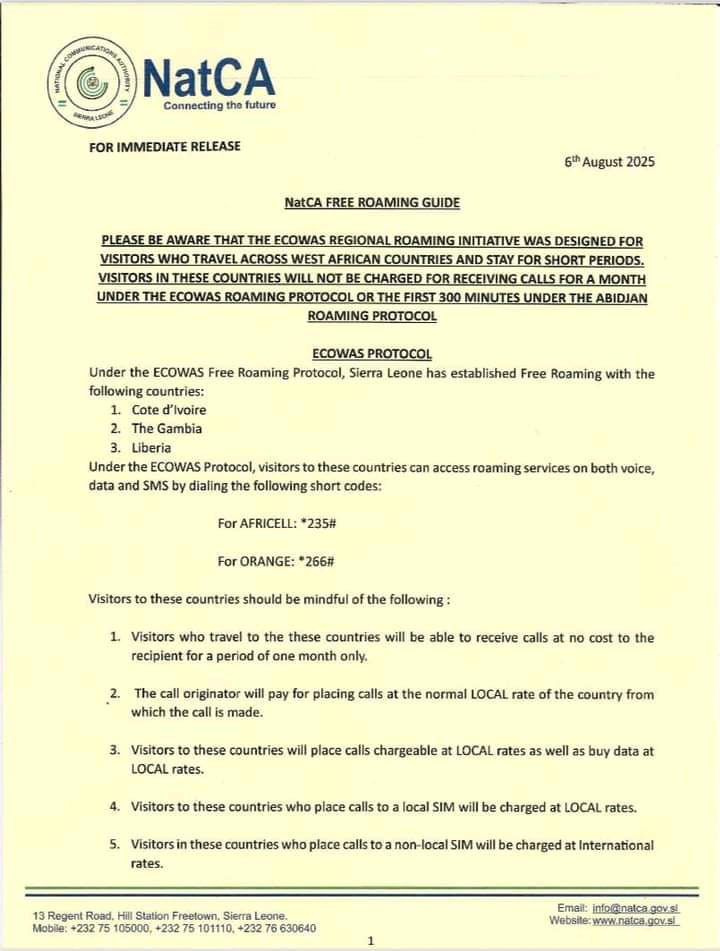
Sierra Leone’s National Communications Authority (NatCA) has formally announced the implementation of regional free roaming arrangements under the ECOWAS Roaming Protocol and the Abidjan Protocol.
The initiative, aimed at reducing the cost of cross-border telecommunications within West Africa, allows Sierra Leonean travelers to enjoy significant benefits when visiting select countries in the region.
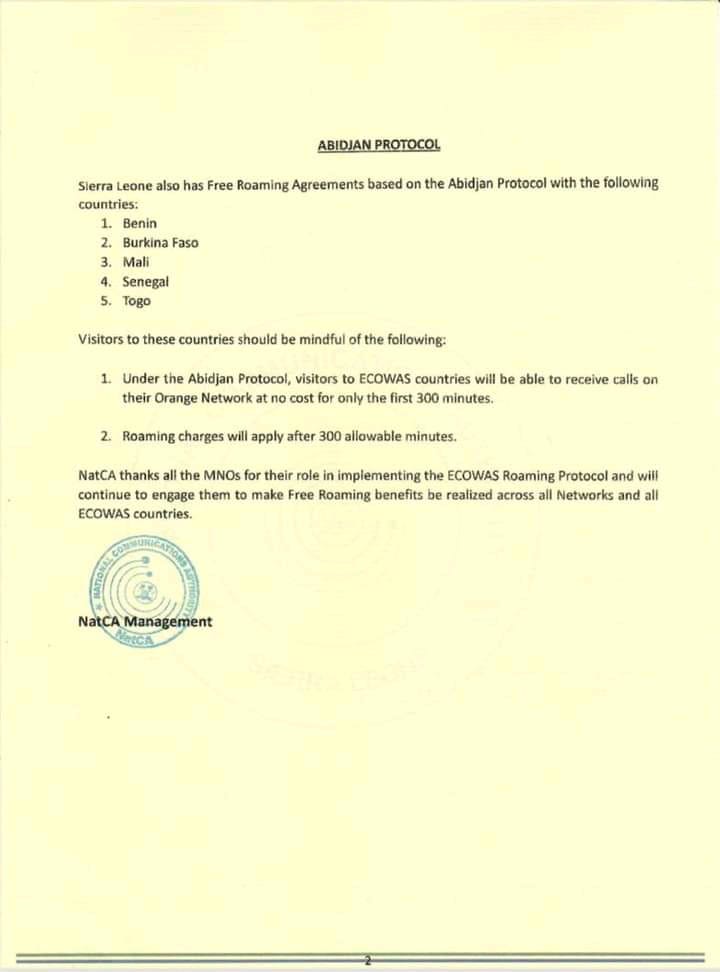
The Abidjan Protocol covers roaming agreements between Sierra Leone and five ECOWAS member states:
Benin, Burkina Faso, Mali, Senegal, and Togo.
Under this agreement, visitors to these countries will be able to receive calls on their different mobile network free of charge for the first 300 minutes. After this threshold, regular roaming charges will apply.
Separately, the ECOWAS Free Roaming Protocol includes agreements with Côte d’Ivoire, The Gambia, and Liberia.
For these countries, visitors from Sierra Leone can receive calls free of charge for up to one month, in line with ECOWAS’s regional goal of enhancing short-term mobility and regional integration.
Roaming Terms and Access
To activate roaming services under these agreements, users can dial the following short codes:
Africell: *235#
Orange: *266#
Calls made by visitors to local numbers will be charged at local rates.
Data services will also be billed at local rates.
Calls made to non-local SIMs will attract international charges.
The caller, not the recipient, bears the cost of outgoing calls at local rates of the host country.
NatCA acknowledged the contributions of Mobile Network Operators (MNOs) in implementing the ECOWAS Roaming Protocol and reaffirmed its commitment to working with operators to expand the benefits of free roaming across all ECOWAS member states and networks.
According to the official statement, “NatCA will continue to engage stakeholders to ensure roaming benefits are fully realized across West Africa.” The Authority emphasized that the initiative supports regional integration, economic cooperation, and affordability in telecommunications.
This development is seen as a positive step for travelers, businesspeople, and ECOWAS citizens who rely on cross-border communication, aligning with the broader objectives of the ECOWAS Digital Agenda.