

 Post a comment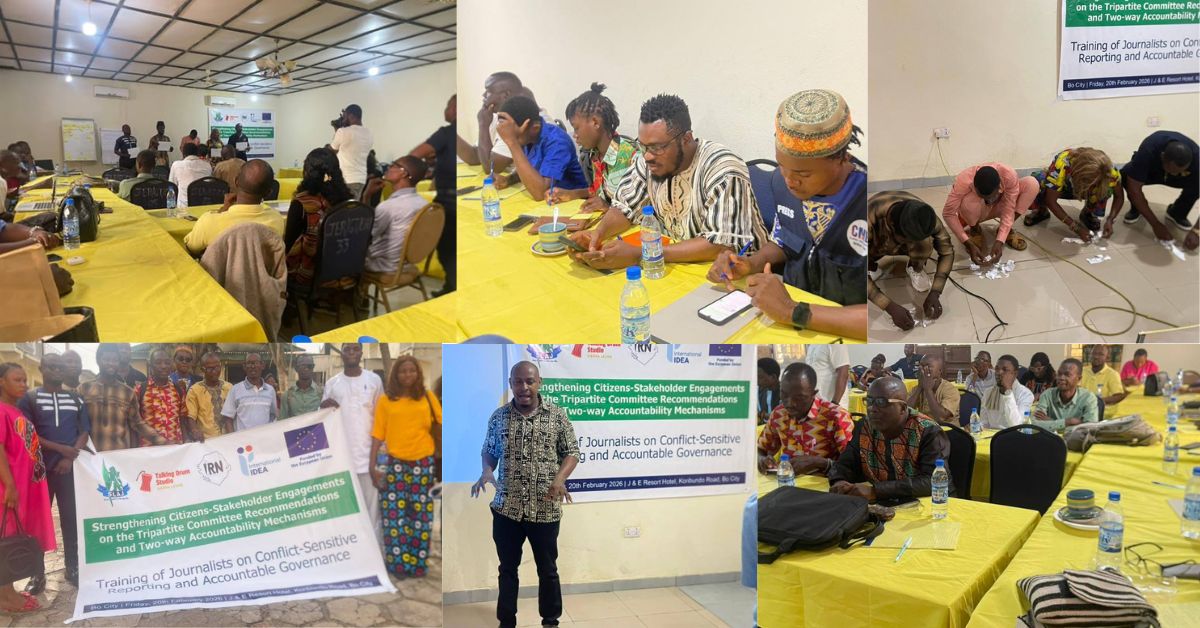
The Sierra Leone Association of Journalists (SLAJ), in partnership with the European Union and funded through International IDEA, has concluded a nationwide training programme aimed at strengthening journalists’ capacity to report responsibly on the Tripartite Process and its recommendations.
The initiative, implemented through a consortium comprising the Independent Radio Network (IRN) and Talking Drum Studio (TDS) as lead partner, engaged approximately 250 senior journalists from across the North, North West, South, East and Western Area regions.
The final training sessions were held at the J & E Hotel in Bo City on Friday, 20th February 2026, and at the Port Loko District Council Hall in Port Loko on Saturday, 21st February 2026, marking the completion of a structured nationwide capacity-building effort that began in July 2025.
The training focused on the people-centred aspects of the 80+ recommendations emerging from the Tripartite Process. Sessions addressed conflict-sensitive reporting, accountable governance, common ground journalism, and the media’s role in promoting two-way accountability between citizens and institutions.
Regional State Counsel for the Southern Region, Augustine Sheku Esq., led discussions on the substance of the Tripartite recommendations, stressing the need for journalists to fully understand complex political and legal reforms in order to properly educate the public. Journalism lecturer James Tamba Lebbie facilitated sessions on applying conflict-sensitive approaches when covering politically sensitive issues.
Speaking during the closing engagements, SLAJ President Alhaji Manika Kamara thanked the European Union and International IDEA for their continued investment in strengthening media professionalism.
He noted that the training comes at a critical moment as Sierra Leone prepares for another national election cycle amid ongoing debate surrounding the implementation of the Tripartite recommendations and proposed electoral reforms.
”Journalists can only discharge their responsibilities effectively when they fully understand the issues at stake. As the country moves towards another election cycle, the media must rise above partisanship and focus on accurate, people-centred and conflict-sensitive reporting that strengthens democratic stability,” Kamara said.
Participants identified several challenges affecting coverage of the Tripartite recommendations, including limited access to simplified public versions of the recommendations, political polarisation, online misinformation, safety concerns, and limited technical understanding of electoral reform proposals currently before Parliament.
Many journalists called for continued engagement beyond training workshops, including stronger editorial support systems, peer-learning networks, and deeper capacity building on legislative reporting.
Ahmed Sahid Nasralla, Ex-Officio of SLAJ and Project Coordinator working closely with Talking Drum Studio, described the initiative as strategic to Sierra Leone’s democratic future.
”This project goes beyond training journalists; it is about strengthening the democratic fabric of Sierra Leone. When media practitioners understand complex political processes like the Tripartite recommendations and electoral reforms, they are better positioned to bridge the gap between citizens and institutions,” he said.
The conclusion of the nationwide training marks a significant step in reinforcing responsible journalism and strengthening the media’s role as a stabilising force in Sierra Leone’s democracy.


