

 Post a comment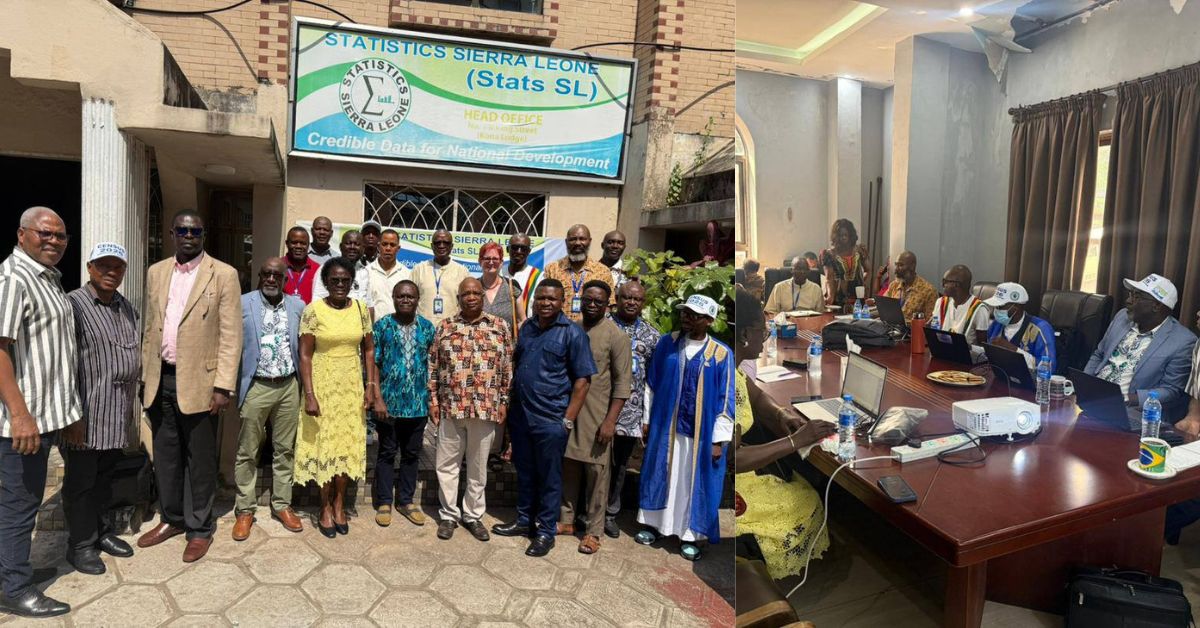
Statistics Sierra Leone (Stats SL) has convened a high-level briefing with international Independent Monitors at its Conference Hall at Kona Lodge to review findings from the Pilot Population and Housing Census, marking a key milestone in preparations for the national census scheduled for 2026.
The briefing brought together representatives from regional and international partner institutions, including the United Nations Population Fund (UNFPA), the United Nations Economic Commission for Africa (UNECA), the Mano River Union, and the United Kingdom’s Office for National Statistics, alongside senior Stats SL management.
Discussions focused on observations, risks, and recommendations arising from the pilot census monitoring exercise.
Opening the session, Statistician General Andrew Bob Johnny welcomed participants and thanked them for their technical support. He described the monitors’ feedback as timely and essential, providing Stats SL with a full year to address identified challenges ahead of the main census.
“The value of discussing these observations in person especially operational and physical issues cannot be overstated,” he said, assuring participants that all recommendations would be carefully reviewed and acted upon.
The Statistician General outlined three priority areas identified by the Independent Monitors: shortening the census questionnaire to align with international standards and improve efficiency; strengthening stakeholder engagement, particularly to capture disability-related and other country-specific data needs; and fully transitioning from Paper and Pencil Interviewing (PAPI) to Computer-Assisted Personal Interviewing (CAPI) to enhance data quality, efficiency, and interview duration.
Director and National Census Coordinator Abdulai Salia Brima reported that the census programme remains on track despite some challenges. Preparations for the 2026 Census formally commenced in 2024 following the validation of a comprehensive project proposal by UNFPA and the European Commission.
He mentioned notable progress since the country conducted its first-ever digital census in 2021, including public acceptance and improvements in the CAPI system. The pilot census was designed to rigorously test systems, applications, and operational readiness in collaboration with UNFPA and UNECA.
Independent Monitors participating in the exercise included Algernon B.C. Johnson (Mano River Union), Omar C.F. Kebbeh (Gambia Bureau of Statistics), Tapiwa Jhamba (UNFPA Headquarters, Nairobi), Rachel Shipsey and Garnett Compton (Office for National Statistics, UK), Collins Opiyo (UNFPA Nigeria), and William Muhwava (UNECA).
They reported high levels of enthusiasm, awareness, and understanding of the census among field staff and local authorities, commended adequate staffing, improvements in CAPI performance, and effective technical problem-solving. The diversity of pilot areas was also praised, with a recommendation to include an elite area in Freetown in future testing.
However, several risks were highlighted, including limited use of operational data for field management, a projected financing gap of approximately USD 13 million, and the potential strain on Stats SL from concurrent surveys such as the Multiple Indicator Cluster Survey (MICS) and the Demographic and Health Survey (DHS).
Independent Monitors are expected to submit their final reports to UNFPA and Stats SL, after which UNFPA will consolidate the findings. Stats SL will respond with action plans, revise census tools and training materials, and organize a data analysis and evaluation workshop to inform final preparations.
Deputy Statistician General Lansana Kanneh thanked the international monitors for their support, describing the pilot monitoring as a critical innovation that allows sufficient time for improvements before the main census.
He reaffirmed Stats SL’s commitment to best practices, inclusivity, and transparency, emphasizing a renewed approach to foster national ownership under the principle of “a census by the people and for the people.”
The briefing concluded on an optimistic note, with stakeholders confident that lessons from the pilot census will significantly strengthen preparations and ensure a credible, inclusive, and high-quality Population and Housing Census in 2026.


