

 Post a comment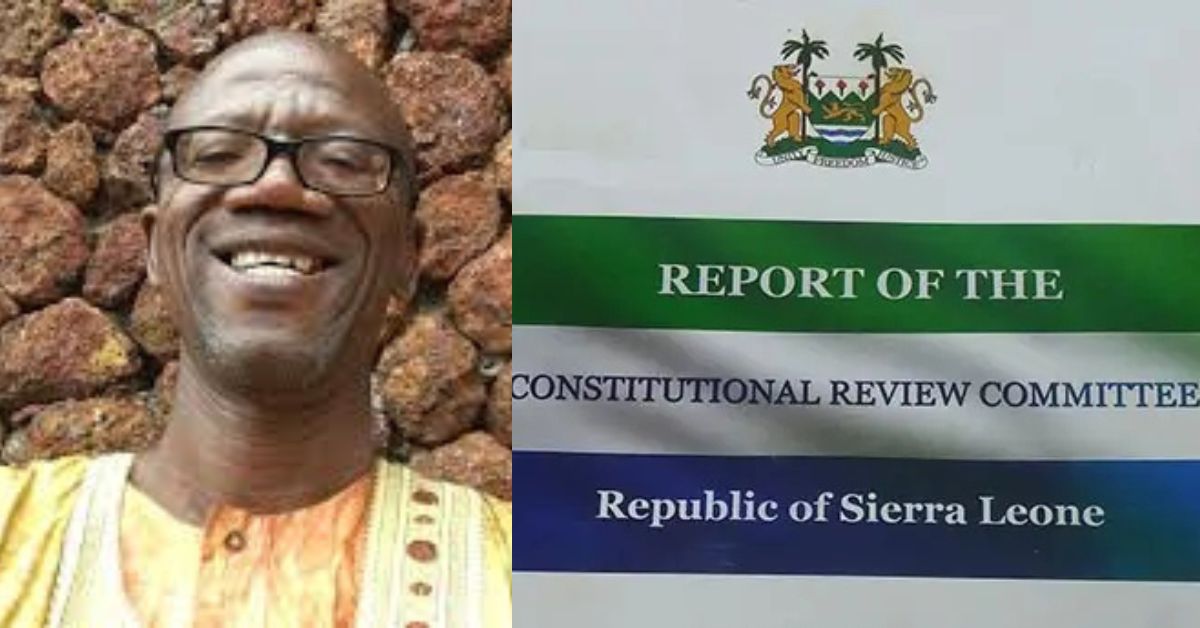
I was in the middle of doing an article on APC flagbearers when these constitutional amendments arrived like some ugly badly dressed ‘orkoh’. So, I shelved that piece for a few days. These constitutional amendments demand attention. They are dangerous. And frankly, they smell.
Let me begin from far away.
In my late teens, early twenties, I was an avid draughts (checkers) player. Two types of draughts existed in Freetown. The “government type” and the “nor to government type.” The government type involved gambling. Ar day play government means I am gambling in draught. The nor to government type involved pride, wisdom, bragging rights, and men with time on their hands. No money lost. Just ego.
I played government because, well, it was also the reigning wisdom that you could not be a good draught person without playing government. But I gravitated most times to the more common nor to government draught.
I used to go to a place called Wembley, along Malta Street. It was an indoor gathering space for mostly elderly men. They allowed me to sit with them because the old men saw me as (hmmmmm) quiet, respectful, and “trying in school.” In those days, that counted for something. I learned a lot there. Politics. Life. Jokes. Gossip. Memory. Philosophy. One day, the discussion turned to latrines.
Why, someone asked, are latrines in compounds and what they called ‘adjoining’ almost always pushed to the back? Especially when that distance disadvantages old people who have to walk slowly to reach them?
One old man answered with mischievous seriousness.
It is because, he said, old people’s bellies are weak. Their farts are louder. Their smells are stronger. The distance protects the rest of the compound from the noise and the stench. It allows the old men to sustain their respect.
Everyone laughed. But the point landed.
Some things, by their noisily foul nature, should be kept away from the centre of communal life.
That is how I see these constitutional amendments. As the construction of a constitutional latrine right in the middle of the public “adjoining”. Right beside the eating place. Where the smells of bad faith and the sounds of political dishonesty cannot be escaped. And ‘ayybo’, the sloppiness of the construction, of words carelessly thrown about; of hurrying sentences that contradict themselves, and more.
They give us ‘reforming politics’ as justification. Nope! No! None! The amendments could, in the first instance, be seen as an attempt at retrofitting legitimacy.
We are dealing with a government whose election is deeply contested nationally and internationally. A government that still has not published full, disaggregated results. A government facing an opposition that, even by its own declared figures at gun point secured over 40% of presidential votes. An opposition that controls roughly half of local councils across the country.
Yet this same government proceeds to rewrite the constitutional order as though it enjoys overwhelming moral authority.
That is bad faith. A ‘baddest’ form of what we may call “shinka politics”. And this did not begin with the constitutional amendments.
This latrinisation of national processes has been ongoing. It often begins with arguments that sound brilliant on the surface. Technocratic language. Reformist vocabulary. Progressive packaging. But underneath, the politics is crude, ‘shinka’ like.
We saw it with the census. We saw it with the sudden introduction of proportional representation during the last parliamentary elections. These were presented as modernising moves. As democratic innovations. But they were also part of a power grab. A power grab that did not even go smoothly, because our friends are also very incompetent at behaving convincingly even to a child. So, the power grab had to become incompetent brazenness on the day the election results were announced: a spectacle of “think-of-any-number” presidential result. Just enough to cross the 55 percent threshold. Just enough to avoid a second round. Just enough to declare victory without providing the underlying data. A first-round win announced like a cheap ‘shinka’ trick of showing paper shine-shine as real gold.
This is the soil from which these amendments grow.
History teaches us that such amendments rarely end well. Albert Margai once designed similar constitutional and electoral “latrines.” When Siaka Stevens later took power, those same tools were turned against the SLPP. Bad faith architecture always outlives its builders. And it always serves whoever wields power next.
If we step back, constitution-making in Sierra Leone has broadly followed three paths. First are constitutions that openly constrict political space. The 1978 One-Party Constitution belonged clearly here. It made no pretense. It narrowed pluralism and formalised authoritarian control. Second, are constitutions that openly expand political space. The 1991 Constitution, whatever its later distortions, reintroduced multiparty democracy and widened civic and political freedoms. In fact, since 1996, it has largely guided the expansion of democratic space in the country. Yes, there have been flaws. Sure, there have been moments that justified reform to deepen accountability and strengthen representation. That was the original warrant for reform. But what is now being offered is not a strengthening of that space. It is a shrinking of it; a ‘shinka’ dressed up as improvement.
That is why these amendments belong to a third and more dangerous category: the ‘nafiki’ constitution. The hypocritical constitution. In everyday Sierra Leonean speech, ‘nafiki’ describes the person who speaks virtue but practices duplicity. The idea draws from the older moral understanding of hypocrisy as presenting a clean face while concealing corruption within. But it has long escaped religious boundaries and become a powerful descriptor in our social life. These amendments sit precisely within that tradition. They speak the language of reform. They borrow the vocabulary of modernisation. They perform concern for inclusion. Yet beneath the wrapping lies a set of changes that weaken accountability, distort representation, and consolidate control. The genuine warrant for reform is being quietly replaced with something smaller, thinner.
The amendments go to Parliament for approval. Parliament will grant the permit for the construction of this constitutional toilet.
But what kind of parliament is this?
A parliament produced by the same disputed electoral process. A parliament where representation has become almost comic. During the 2023 elections the electoral commission picked any number they liked from a district and assigned it seats. In the Western Area, the difference between SLPP and APC was reportedly just two seats. A case of the ‘baddest’ roguery in the last elections. And in Port Loko and other places, seats appeared to be acquired on the fly, with figures that invite disbelief rather than confidence.
And this is the body that will authorise the rebuilding of the constitutional order. When people are “korlicked” with power, and could nor longer control their political fouling of the air, they seek to convince that political farting is normal.
Let me be clear: there are good people in that parliament. I know quite a number of them personally. Some of the highest-ranking among them were once my students at the university. Intelligent people. Decent people. Respectful people.
But this is no longer about personal decency. This is about institutional legitimacy. This is about whether a parliament born under a “korlick” electoral fart should be so brazen to give the permit to erect a ramshackle political latrine at the centre of national life.
There is also a deeper problem. One about the social bases of representation, political imagination and expectations.
Representation in Sierra Leone has been evolving in a socially grounded way. Political parties organise themselves through wards and constituencies. They build legitimacy from community proximity. That structure reflects how people understand belonging, loyalty, and political voice.
These amendments disrupt that organic architecture. They lump constituencies into a single district-wide block in ways that blur community identity. They weaken place-based representation.
Some argue that the amendments increase women’s representation. That goal is correct. The method is lazy.
There are smarter, socially embedded ways to achieve gender equity. For example: merge two adjacent constituencies and elect the top man and top woman from each merged seat. You achieve 50% women’s representation nationwide, structurally, not symbolically. You preserve community identity. You strengthen legitimacy.
Likewise, for parties that gain significant votes in a district but win no seat. The fix is simple. Introduce threshold-based compensatory seats at district level. One or two seats allocated to parties that cross a vote threshold but fall short in constituency contests.
This approach respects community. It respects party diversity. It respects democratic logic. It reflects how political parties already organise themselves internally. It builds place based representation that is familiar to citizens. That matters.
An additional way to anchor power is to ground a large part of central executive power more firmly in elected representation. For example, at least half of all ministers should be appointed from among Members of Parliament. That would correct a serious structural and social distortion in our current system. Under the current constitutional arrangement, only non-MPs can be appointed as ministers. Yet ministers are the real holders of power. In this society where citizen experience power as downstream implementation rather than upstream policy making, ministers have greater power to move downstream, to affect what happens downstream. They are the government’s action people. But because all are appointed from outside Parliament, many of them are politically ungrounded. They do not depend on constituencies. They do not feel the daily pressures of community life. Power, in their hands, floats above society.
This was not always the spirit of representation in Sierra Leone. In earlier political practice, MPs were often appointed as ministers and were widely seen as drivers of action and authentic representatives of the people. That political memory has not disappeared. Citizens still expect their MPs to “do things” – to fix downstream problems, intervene in local crises, and deliver tangible outcomes. MPs themselves carry that expectation, even though constitutionally they no longer possess the authority or capacity to perform such roles. The result is a profound misfit: ministers hold power without grounding, while MPs carry representation without power. Both become alienated. One governs without intimacy; the other represents without agency. That structural contradiction must end if constitutional reform is serious about deepening democracy rather than rearranging control or papering structural nastiness.
I understand the reasoning behind appointing ministers from outside Parliament. There are many capable people with deep expertise, technical competence, and valuable experience who simply do not have the temperament, resources, or appetite for the rough terrain of electoral politics. A democratic system should be able to draw on such talent. But the problem arises when this exception becomes the rule. When all ministers are drawn from outside Parliament, power is systematically pulled away from the social grounding that should animate it. Executive authority becomes increasingly detached from lived political life, insulated from electoral pressure, and distant from everyday accountability.
Worse still, ministerial appointments often drift away from the technical competencies originally envisaged and instead become rewards for political bag carriers, “flux mango” men, praise-singing “dregman dem” and many who do not know their “left from their right” but fished from wherever some baser convenience allows. Many arrive, perhaps skilled mainly in threatening opponents, or amplifying the glory of a top man. Is that the envisaged technocracy? It reminds of what they say in Eastern Freetown is the immediate consequence of taking Kush, the Krio double verb for emphasis: ‘nod-nod’. ‘So so nod nod’ dressed as governance. The overall outcome is democratic thinning: power without roots, expertise without intimacy, authority without consequence, and a sizable caboodle of ‘nod nod’ people. A serious constitutional reform should therefore seek balance, not exclusion, and seek to restore the link between executive power and elected representation rather than further severing it.
Then, there is the proposal around the appointment of the Chief Electoral Commissioner. A “Search Committee” sounds attractive. But we have learned to fear attractive words without binding mechanisms. Who defines civil society? Who controls the shortlist? How binding is the search?
We have seen the latrinisation of serious national processes before. The Tripartite Committee. The August 10, 2020 Pademba Road Prison massacre inquiry. Committees formed with public language and private capture.
Civil society itself has become a fouler terrain, what a keen observer calls the constriction of the civic space, a silencing of many voices. Now many of its loudest voices have become what a long dead Russian political organizer called “useful idiots” for power.
And yet, I want to be fair.
The formal architect of these constitutional amendments, Alpha Sesay, is by all accounts a fine gentleman. Personally courteous. Respectful. Decent. I say this from direct experience. But perhaps I say this because he’s a Sesay like me, and I am nepotist about Sesays. But many others say the same about his personal decency and intersectional respect.
But keen observation teaches us something uncomfortable. Nice people can still advance bad projects.
There are several types of actors in politics. Those who implement harmful agendas with cruelty. And those who implement them with courtesy. The outcome remains the same. The latrine still stands in the middle of the compound. Only the tone of voice during construction differs.
Mr. Sesay may carry the project gently. Others carry it aggressively. But the structure remains a rickety constitutional latrine in the heart of the political adjoining with badly written sentences about where to piss or not to piss.
Beyond just being a legal document, a constitution is a moral architecture. It tells citizens whether power respects them, listens to them, and belongs among them; or whether it only tattoos rules over them, sometimes in a ‘nod nod’ way, pushing greater poisons into the body-politic. What we are witnessing here is not the careful renovation of a shared civic house. Rather it is the hurried erection of a political structure that smells of bad faith, weak foundations, and dangerous intent.
Wrapped in the language of reform, it hollows out representation. Sold as inclusion, it concentrates ‘shinka’. Presented as modernisation, it drifts further from the lived realities of ordinary people. And where the public square is forced to host a constitutional latrine, the responsibility of citizens is not to admire the plaque – A Bill Entitled bla bla bla; but to refuse the construction


