

 8 Comments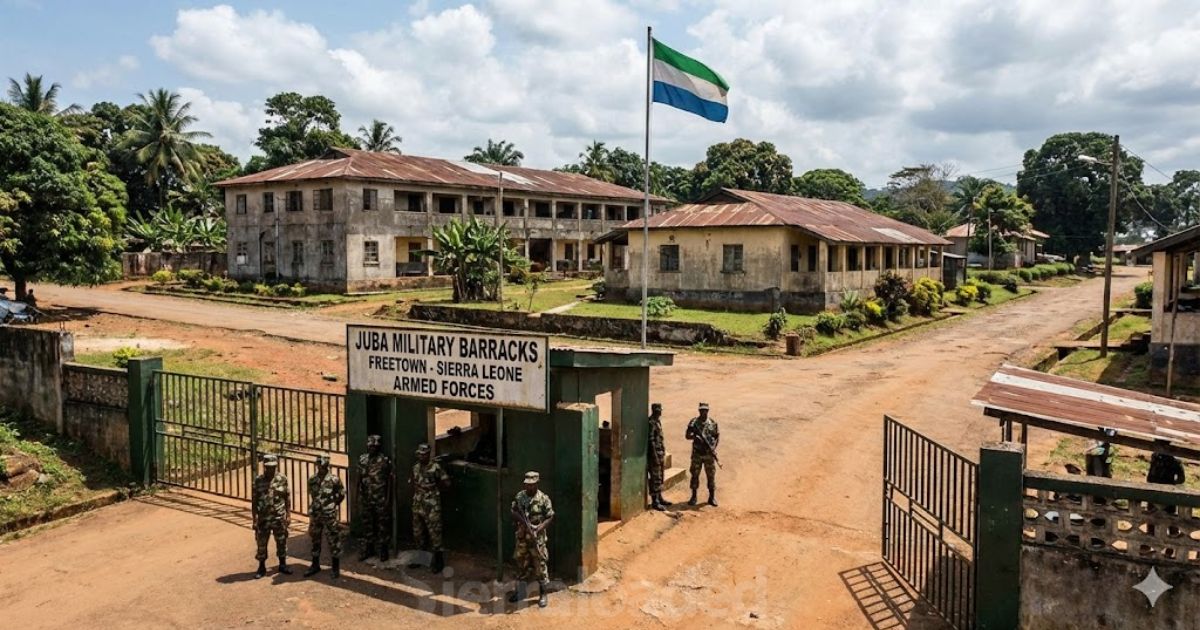
A nation must ask questions when matters of security and public land arise.
During an interview on Radio Democracy’s Good Morning Salone, the Air Commodore, Chief of Air Staff and Defence Spokesperson, Hassan Sei Coomber, confirmed that the Defence Council of the Republic of Sierra Leone Armed Forces (RSLAF) has approved the sale of Juba Military Barracks. According to him, the decision is part of a strategy to raise funds to improve military infrastructure.
His explanation was direct: some barracks in Sierra Leone sit on high-value land. By selling certain properties and engaging in public-private partnerships, the military intends to generate resources to develop better accommodation and facilities. He also stated that about 70% of military personnel currently live outside barracks due to housing shortages. The argument, therefore, is that selling high-value properties could help solve internal accommodation challenges.
On paper, that sounds practical. But in reality, it raises serious national questions.
What Is Juba Barracks?
Juba Barracks is not an ordinary property.
It reportedly sits on about 20 acres of land and contains 18 quarters. It is located near the Atlantic coastline and overlooks one of the most populated areas in Freetown.
Strategically, it is one of the most significant military locations in the country.
Socially, it is home to families, children, and community institutions.
Economically, it sits on land of high commercial value.
Part of the land has reportedly already been sold to LOR Restaurant/Business Centre, and it is alleged that the same entity is interested in acquiring the entire property. These reports require official clarification.
The Core Questions
This is not about accusing anyone. It is about clarity.
Who exactly is buying Juba Barracks?
What is the full value of the transaction?
Was there a public bidding process?
Has Parliament been informed?
What safeguards are in place to protect national security?
When military land is sold, it is not just a real estate deal. It is a national security decision.
The Slip of Tongue: Why It Matters
During the interview, the Defence Spokesperson appeared to begin saying, “We done get President Bio ihn approval,” before correcting himself to say, “We done get Defence Council approval.”
It may have been an innocent slip of the tongue. But in governance, words matter. In a system where the President is Commander-in-Chief, citizens naturally want clarity on who approved what.
Was this solely a Defence Council decision?
Was there executive endorsement?
Was it a collective state decision?
Transparency removes suspicion. Silence fuels it.
Some citizens argue that selling Juba Barracks is risky. They believe:
Its coastal location makes it strategically important.
Relocating such a base could weaken military presence in a key area.
Once sold, the land is permanently lost to civilian or commercial control.
Others argue that modernization sometimes requires difficult decisions. If 70% of soldiers live outside barracks, the military’s internal welfare system is already strained.
The real issue is not whether development is needed.
The issue is whether selling strategic land is the only or best solution.
Beyond security, there is the human factor.
Juba Barracks is home to families, schools, and children. Selling it would not just relocate soldiers. It would disrupt communities, education systems, and livelihoods.
Development must improve lives not displace them without clear and fair alternatives.
This decision comes at a time when the RSLAF is still recruiting new soldiers. If housing shortages already exist, citizens are asking:
Is it wise to reduce existing infrastructure before new accommodation is fully secured?
Military strength is not only about recruitment numbers. It is about logistics, housing, morale, and stability.
Public land belongs to the Republic. The military protects it it does not own it personally. Citizens have the right to demand transparency in how national assets are managed.
Asking questions is not unpatriotic. It is civic responsibility.
This should not become an APC versus SLPP shouting match. National security decisions must rise above party politics.
If the deal is sound, publish the details.
If it is beneficial, show the cost-benefit analysis.
If it is strategic, explain the strategy clearly.
Democracy survives on openness.
Selling Juba Barracks is not just about land. It is about trust.
Once strategic national property is transferred, it cannot easily be reclaimed. That is why decisions like this must be transparent, carefully justified, and publicly understood.
The real question is not only “Who is buying?”
The real question is: Will Sierra Leone gain more than it loses?
History will answer. But citizens are right to ask now.


This is crazy, a military barracks is sold to the public and other private entities. Something that has the defense mechanisms of the country, I’m still wondering what is going on in our beloved Sierra Leone. Things are changing quickly beyond expectation, is this also about politics?
President bio had made history, but it’s a bad name history . For me i will never forget what you are doing and I will explain that history to my children
I have some doubts in this deal. Knowing fully well how strategic the Juba Barracks is located, I begin to think who came up with that idea of selling that piece of land. To me this is national suicide. Why can’t the Defense Council rethink and consult properly. This is common sense; the site (appropriately 20 acres) could be developed to host more billets for the growing number of our soldiers instead of leasing or selling the land to foreign business people who cannot benefit the suffering masses. Take for instance the duplex structure for officers recently constructed at Wilberforce. More of these could have been constructed at Juba with modern military equipment to boost the military. Those who thought of that idea of selling that barracks I believe are in their late 50s. Please let them think of the future; majority of those few people will not live to see the completion of whatever structure that will be constructed on that piece of land. Can’t they think of people who have gone through Services Secondary School in Juba and the present students attending that school? This is shameful and sinful in my view . The way forward: think of taking the proposed buyers to the Industrial Zone in Koya where they can do business in a bigger plot as well. I begin to doubt in my personal view why should the Defense Council should just pick on Juba and what kind of business the proposed buyers plan to do in that land. A food for thought. I rest my case. “Oh Sweet Mama Salone. Udat gbain get gud plan for dis kontry”?
They haven’t started saying opposition is trying to overthrow the president ooo.
This is really disgraceful
Jubba baracks is not a military property it is the property of us sierra Leonan population selling strategic plots of lands all around the country to private entities and foreign inventory all in the name of basic amenities for soldiers is a lie if the army chief of staff who is our president knows that soldiers are suffering then let him stop the recruitment for now and put the force on their foot with stable housing and stop wasting our resources
After juba we dae go sell cockery back! Natin we nor dae lef for A*P*C*. Una wait small, unu go see sometin 🤔
Can one ask this question? Who actually first came up with this idea of SELLING Juba Barracks ? The barracks is situated on a twenty acres land with only 18 quarters. And 70 % of the military personnel are staying outside of the barracks in the community. Strategically construct more accommodation facilities in order to house a large number of the personnel who are currently in the community ?
Salone dey beyen fors.