

Who Will Win 2028 Presidential Election for APC?
 Guest Contributor
 The recent political boycott has been put to rest. The All People’s Congress, international moral guarantors intervened to resolve the standoff and steer the parties towards organizing itself for the task ahead.
Many Sierra Leoneans are of the notion that power is taken, not given. That belief is shaping strategic thinking within the various camps of the APC as they regroup themselves for the 2028 general elections.
The party views the just concluded mediation process as the final window for credible action and an opening to reset the terms of future competition.

Since the contested 2023 elections, sections of APC supporters still believe that elections were stolen. At the same time, the party is seeking to harness public frustration over economic hardship, rising unemployment, and the spread of Kush, a growing public health concern that has sent hundreds of innocent souls to there early grave.


On that basis, many supporters of the APC argue that the national mood strengthens their electoral prospects, reducing the need for extensive political campaign.
some believe that the best is placed to restore stability, rebuild public trust, and reverse what it describes as governance failures. And there is a strong conviction by party supporters that it is only the APC that can reset the country’s development trajectory and fix all the broken promises.
Yet, as electoral history shows, early confidence rarely guarantees victory. In delegate politics, every contender is effectively a frontrunner until ballots say otherwise.
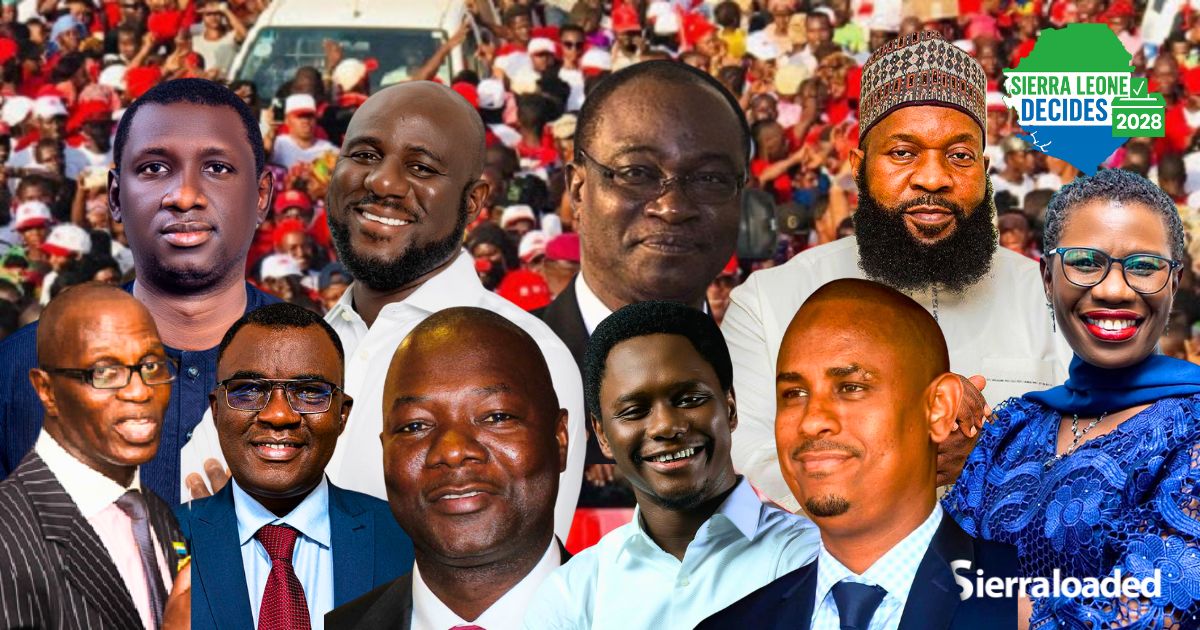
At the centre of the APC’s internal debate are three prominent figures widely seen as leading contenders for the party 2028 flagbearer position: Dr.Kaifala Marah, Dr. Ibrahim Bangura, and Dr. Richard Konteh.
Intrestingly, many people believe each of the contender represents a distinct political identity but only one will emerge as flagbearer, each represents a different answer to the same question: what kind of leadership does the APC need to return to power.
Dr Kaifala Marah the economic Technocrat, he stands out as one of the most experienced figures in the race.
A former Chief of Staff and Senior Economic Adviser under President Ernest Bai Koroma, his career has been defined by high-level economic management and executive coordination rather than grassroots politics.
He later served as Minister of Finance in 2013, where he led fiscal reforms, before being appointed Governor of the Bank of Sierra Leone in 2016.
For many within the party, Dr. Marah’s strength lies in his economic credibility a potentially decisive advantage at a time when voters are increasingly concerned about the cost of living and employment.
He represents a leadership model grounded in policy delivery rather than political theatrics. However, his previous attempts to secure the APC flagbearer position in 2018 and 2023 exposed a persistent challenge translating technocratic expertise into broad-based political support.
As of today, many believe If he can bridge that gap by strengthening grassroots networks, he could emerge as a formidable contender. If not, he risks remaining the party’s most qualified candidate without the electoral traction to match.
Dr Ibrahim Bangura the Reformist, offers a distinct different profile.
Many support from the APC and other political parties see him as the next president of Sierra Leone. That is visible as his face is on hundreds of front pages on newspapers in the country.
For many he stands apart from the traditional mould of APC leadership contenders. His profile is rooted not in party hierarchy or government office, but in academia, international development, and peacebuilding.
Dr Bangura has worked as a European Union results-oriented monitoring consultant since 2010, evaluating development projects across more than 30 African countries. His contributions to ECOWAS policy frameworks and his academic role at Fourah Bay College further reinforce his credentials.
With over 18 years’ experience in governance, post-conflict development, and environmental policy, Bangura’s career has been shaped by complex global challenges.
Supporters argue that this gives him a distinctive appeal, particularly among younger voters and reform-minded constituencies. His message is clear for the APC to win, it must change.
Bangura may be better positioned as a policy influencer he represents a potential future direction for the party one that prioritises reform, ideas, and technocratic governance.
Dr. Richard Konteh Unifier he positions himself as the candidate of unity.
His core argument is straightforward that a divided party cannot win. Drawing on years of experience within government and party structures, he presents himself as a bridge between competing factions.
Konteh has held several senior roles, including Chief of Staff in 2012, Minister of Trade in 2010, and Deputy Minister of Finance in 2007 under President Koroma. This background gives him both administrative experience and political grounding.
His second-place finish at the APC National Delegates Conference in 2023 demonstrated that he commands tangible support within the party and understands the mechanics of internal competition. His supporters often refer to him as “D-Unifier”.
Even so, his path is not without obstacles. To strengthen his candidacy, he must consolidate his existing base while expanding his appeal beyond core party loyalists.
All in all, taken together, the three candidates reflect the strategic choices facing the APC.
Marah offers economic expertise and policy depth. Konteh represents unity and internal political strength. Bangura embodies reform, ideas, and generational change. The party must now decide which of these attributes matters most in the context of 2028.
Dr. Kaifala Marah is the most experience and loyalists among them.
The only politician with clean record.
We the people of this country are urging the APC party to please! Gives us Dr. Kaifala Marah.