

 Post a comment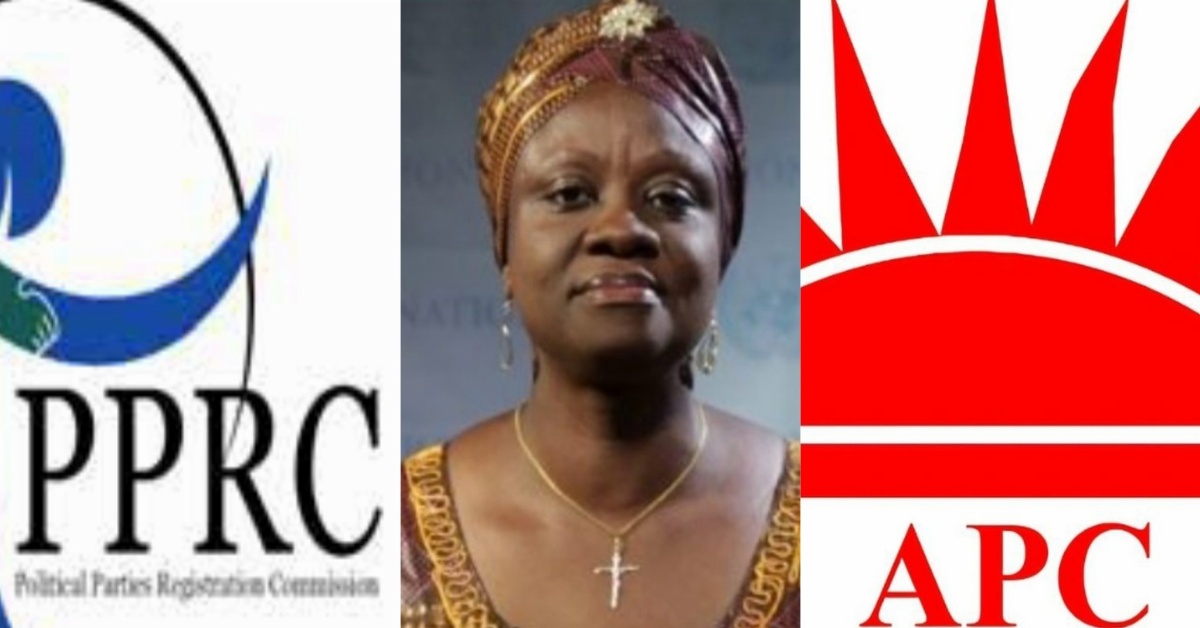
A senior stakeholder of the All People’s Congress (APC), Dr. Sylvia Olayinka Blyden, has formally urged the Political Parties Regulation Commission (PPRC) to approve a six-month caretaker extension for the party’s National Officers, National Executive Committee (NEC) and National Advisory Committee (NAC), warning that their immediate removal would create institutional instability within the party.
In an 11-page Amicus Curiae brief deposited at the PPRC on Friday, January 30, 2026, Dr. Blyden said she was intervening in her capacity as an Honorary Foundation Member of the APC and as a former litigant in the 2021 case of Alfred Peter Conteh versus the APC.
Her brief seeks to oppose complaints filed by Hon. Ambassador Alimamy A. Kamara and Sahr Philip Mani, both of whom are asking the PPRC to remove the current APC executives when their three-year tenure expires in February 2026.
Dr. Blyden argued that the complaints misinterpret both the APC Constitution of 2022 and the Political Parties Act, 2022, particularly Section 39(5), which she said expressly allows the PPRC to approve a one-time extension of party executives for up to six months.
According to her, the law anticipates situations where internal elections cannot be concluded on time and provides a limited mechanism to prevent leadership vacuums.
In her submission, Dr. Blyden emphasized that the APC Constitution deliberately separates political administration from electoral management by establishing an independent Internal Elections Management Committee (IEMC).
She noted that unlike party executives, the IEMC has no fixed tenure and derives its authority directly from the National Delegates Conference, not from the National Executive. As a result, she said, internal party elections can proceed freely and credibly even if the current executives remain temporarily in office in a caretaker capacity.
“The continuation of the elected National Officers for a maximum of six months will not prejudice internal party democracy,” Dr. Blyden stated in her brief. She argued that because the IEMC alone is responsible for preparing ballots, conducting elections and announcing results, there is no risk of incumbents manipulating the process for electoral advantage.
Addressing the specific complaint by Hon. Alimamy Kamara, Dr. Blyden disputed the claim that the tenure of the NAC and other party bodies automatically expires after three years.
She said Article 52 of the APC Constitution only defines the normal length of an electoral mandate, while Articles 17(d), 21(i) and 24(h) clearly state that the authority of the National Officers, the NEC and the NAC ends only when they are dissolved by the National Delegates Conference.
She described this as a constitutional distinction between the “expiry of a mandate by time” and the “termination of authority by a formal act,” arguing that time alone cannot automatically strip these bodies of authority.
According to her, the Constitution was intentionally drafted this way to allow flexibility in circumstances where elections or the National Delegates Conference are delayed.
Dr. Blyden also rejected attempts to use the case of former APC National Leader Dr. Samura Kamara as a precedent. She explained that the Constitution treats the National Leader differently, as Article 47(a)(iv) expressly requires the leader to relinquish and vacate the position after losing presidential elections. She said no similar language exists for other party officers, making the situations legally distinct.
In explaining why the current impasse arose, Dr. Blyden cited delays in the gazetting of PPRC rules due to objections and petitions, which forced the APC to postpone lower-level elections and its National Delegates Conference. She warned that enforcing a strict interpretation of tenure under these conditions would leave the party “rudderless” and administratively paralysed.
Drawing on her personal experience in the 2021 court case that led to the creation of the Interim Transitional Governance Committee (ITGC), Dr. Blyden cautioned against any new interim arrangement imposed on the APC.
She described the previous interim structure as “a disaster” that weakened the party and hampered its ability to function effectively. Instead, she proposed that the current leadership remain in a limited caretaker role under the direct oversight of the PPRC.
Dr. Blyden also questioned the timing and good faith of Hon. Alimamy Kamara’s complaint. She noted that the APC Constitution requires six months’ public notice before a National Delegates Conference can be convened, arguing that concerns about tenure should have been raised as early as August 2025. She said the decision to remain silent until just before the perceived expiration of tenure raises concerns about the motive behind the complaint.
In her conclusion, Dr. Blyden maintained that there is no fixed constitutional tenure for the NAC and NEC, and that while the three-year term of National Officers may expire, their authority continues on a caretaker basis until dissolved by the National Delegates Conference.
She stressed that the proposed continuation would be lawful, temporary, non-self-serving and capped at six months, in line with the Political Parties Act.
She urged the PPRC to adopt a practical and harmonious interpretation of the law that preserves institutional continuity, avoids what she described as an “absurd” outcome, and allows the APC to complete its delayed internal elections without disruption.


