


 Post a comment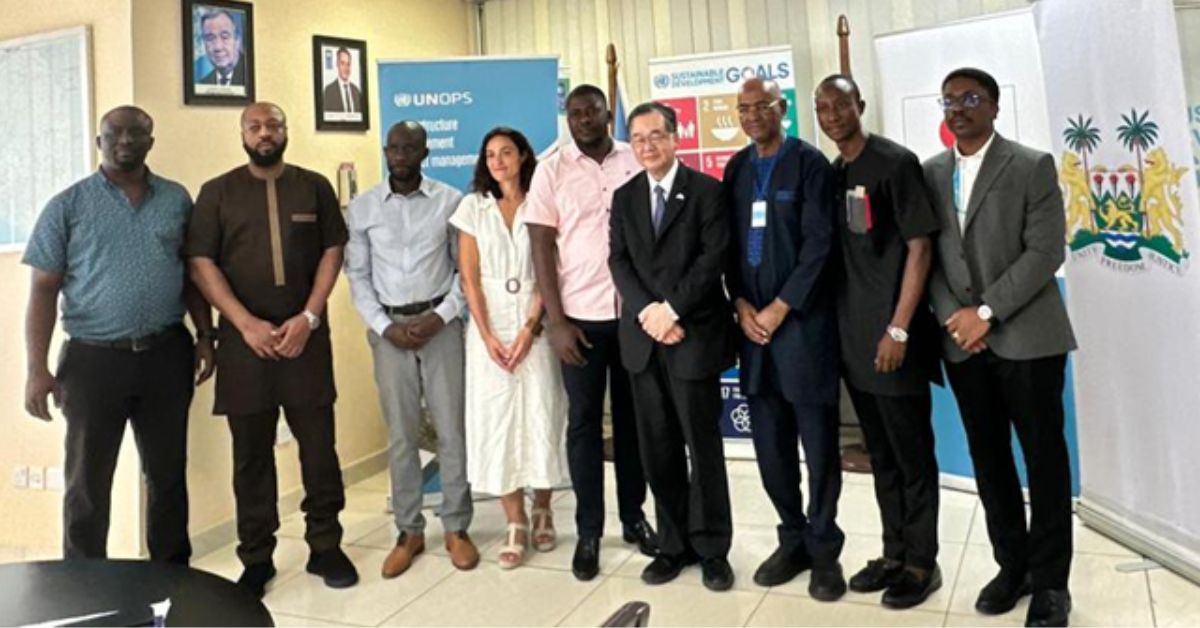
The United Nations Office for Project Services (UNOPS), in collaboration with Sierra Leone’s Ministry of Energy and with funding support from the Japan, on Friday 27 February 2026 officially closed the Project for Enhancing the Impact of Rural Renewable Energy in Sierra Leone.
The closing ceremony was held at the UNDP Conference Room in Freetown.
The project, funded by the Government of Japan and implemented by UNOPS, was carried out in six communities in Bo District. It aimed to improve access to reliable and sustainable electricity in rural areas through the installation of solar power plants and network grid distribution systems.

Speaking at the ceremony, Japan’s Ambassador to Sierra Leone, resident in Ghana, Hiroshi Yoshimoto, congratulated UNOPS, the Ministry of Energy and the Project Steering Committee on the successful completion of the initiative. He said the project, which commenced in 2021, was delivered through patience, collaboration and strong partnerships among stakeholders.
According to Ambassador Yoshimoto, the installation of solar power plants and distribution systems was designed to provide reliable and sustainable electricity. Beyond infrastructure, he described the initiative as a meaningful investment in people and communities and a symbol of enduring cooperation between Japan and Sierra Leone.
He highlighted the long-standing friendship between the two countries, stating that the results demonstrate what can be achieved when nations work together toward shared development goals.
The Ambassador said the project would have a positive and lasting impact on rural communities and represents a step toward inclusive development as Sierra Leone advances its electricity sector reform agenda.
He encouraged stakeholders to ensure proper management and maintenance of the facilities to guarantee long-term sustainability. Ambassador Yoshimoto also noted that Japan’s cooperation in the energy sector continues to expand, citing ongoing electricity supply initiatives along the Freetown Peninsula supported by the Japan International Cooperation Agency (JICA). He recalled Japan’s previous support for the upgrade of the northern power grid in 2008 and the north-western power grid between 2012 and 2017.
Under Japan’s Country Assistance Policy for Sierra Leone, he said, the focus remains on accelerating economic development and improving public service delivery through basic infrastructure development.
He concluded by thanking UNOPS for the successful implementation of the project and reaffirmed Japan’s commitment to continued partnership to improve electricity access in Sierra Leone.
Also addressing the ceremony, Deputy Minister of Energy II, Dr. Abdul Rahim Jalloh, said he was honored to witness the closure of the Enhancing the Impact of Rural Renewable Energy (EIRRE) Project.
Speaking on behalf of President Julius Maada Bio, the Minister of Energy and the people of Sierra Leone, particularly those in Bo District, he expressed gratitude to the people and Government of Japan for their support and to UNOPS for its technical expertise.
Dr. Jalloh stated that rural electricity access in Sierra Leone remains at approximately five percent and said the project directly addresses that gap. He noted that the completion of six solar photovoltaic mini-grids will benefit more than 15,000 people in Naiagolehun, Petewoma, Serabu, Grima Tikonko, and Upper and Lower Saama in Bo District.
He said the project goes beyond infrastructure, explaining that reliable renewable energy will enhance public service delivery by enabling health facilities and schools to function effectively.
He added that it will stimulate economic growth, empower small businesses, extend operating hours, increase productivity and reduce reliance on polluting fossil fuels in line with national climate commitments.
According to Dr. Jalloh, the mini-grids support the Ministry of Energy’s Mission 300 and the MCC National Energy Compact, which aim to increase national electricity access from 36 percent to 78 percent by 2030.
He assured stakeholders that the Ministry, together with private sector partners, will ensure proper operation and maintenance of the facilities to guarantee long-term sustainability.
Project Manager Mohamed Suaib Sesay said the results achieved demonstrate the strength of partnership between UNOPS and the Ministry of Energy. He stated that six solar mini-grids and associated distribution networks were constructed across the six communities in Bo District.
Sesay said the project contributes significantly to Sustainable Development Goal 7 on Affordable and Clean Energy. As UNOPS prepares to hand over the project to the Ministry of Energy, he emphasized that sustainability remains the primary focus. “We are not leaving behind stranded assets; we are leaving behind a living system,” he said, noting that private operators will be engaged under a structured operation and maintenance framework to ensure commercial viability and professional management.
He thanked the Ministry of Energy for its leadership and the Government of Japan for its financial and strategic support, describing energy as “the golden thread that connects all development goals.”
The project’s closure notably marks the completion of a five-year renewable energy initiative aimed at expanding access to clean electricity in rural Sierra Leone through international cooperation between Japan, the United Nations and the Government of Sierra Leone.


