


 1 Comment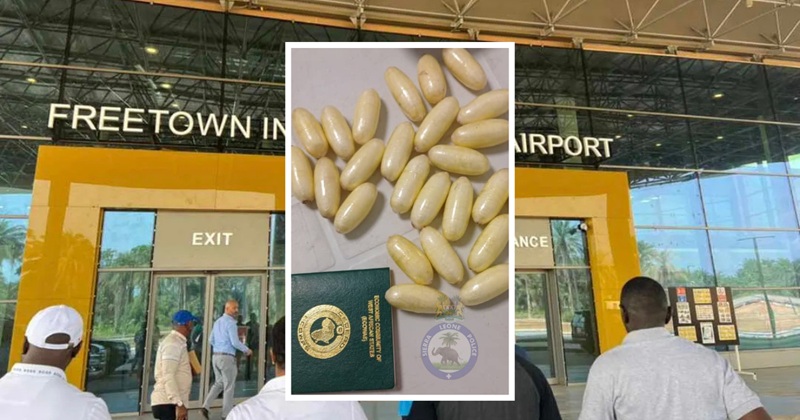
There comes a point in every nation’s story when denial becomes more dangerous than truth.
Sierra Leone may be approaching that point.
For years, drug trafficking was treated as a distant issue something happening around us, not within us. Today, that illusion is collapsing.
Now the question is no longer whispered.
It is being asked locally and internationally:
Are we slowly becoming what the world is beginning to call us?
A vessel leaves Freetown.
Days later, it is intercepted with 35–40 tonnes of cocaine in Spain.
Pause there.
Not kilograms.
Tonnes.

One of the largest cocaine seizures linked to a route involving Sierra Leone.
Yes, no direct evidence has yet tied Sierra Leoneans to that shipment.
But let us stop hiding behind technicalities.
Why is Freetown repeatedly showing up in global drug routes?
How many times does a pattern repeat before we stop calling it coincidence?
Multiple international reports, including the ENACT Organized Crime Index and findings by the Global Initiative Against Transnational Organized Crime, place Sierra Leone firmly within what is now described as West Africa’s “Western Hub” for cocaine movement.
This is not speculation.
This is documented.
These International reports are no longer cautious they are direct.
Meaning:
Drugs move from Latin America
Pass through West Africa
And Sierra Leone is increasingly one of the key doors
So let us ask plainly:
When did we move from being a vulnerable state… to becoming a strategic transit point?
And more importantly:
Who allowed that shift to happen?
One of the most troubling revelations is this:
There have been no major cocaine seizures reported at Freetown Port in at least five years.
Pause there.
At a time when:
Massive seizures are being made in Europe
Routes are being traced back to Sierra Leone
Yet locally:
No significant interceptions
No high-profile disruptions
So the question becomes unavoidable:
Is it that nothing is passing through or that nothing is being stopped?
Are we to believe that:
Drugs pass through everywhere else but not here?
Because in crime, silence is rarely innocence.
Because in crime analysis, absence of seizures does not always mean absence of crime.
Sometimes, it is access.
This issue is no longer just about trafficking routes.
It is about institutional vulnerability.
Reports point to:
Possible complicity within enforcement systems
Corruption linked to drug profits
Penetration of networks into political and economic structures
We have seen:
Embassy-linked incidents involving cocaine
Allegations—whether proven or not—touching high-level figures
Foreign traffickers reportedly operating within the country
Now, whether all allegations are true is not the immediate issue.
The issue is this:
When such narratives persist without clear, transparent resolution, trust begins to erode.
So let us ask the question many fear to say out loud:
Is Sierra Leone being used or is it being enabled?
If this was only about drugs passing through, the danger would still be serious.
But it is no longer just passing through.
It is staying.
Synthetic drugs are rising
Crack cocaine is spreading in urban spaces
So now we must ask:
Are we just a corridor or are we becoming a market?
Because once a transit country becomes a consumption country, the damage multiplies.
Let’s be honest.
Drug trafficking does not survive on invisibility alone.
It survives on:
Weak systems
Compromised institutions
Economic desperation
At the bottom:
Young people are pulled in by survival
At the top:
It becomes about power, protection, and profit
So the real question is:
Who is benefiting from this system and who is paying the price?
Let us be fair:
This is not a problem created overnight.
And it is not unique to Sierra Leone.
But leadership is not judged by the absence of problems.
It is judged by the clarity of response.
So where are the answers?
Where are the high-profile prosecutions?
Where are the visible enforcement breakthroughs?
Where is the transparency when serious allegations emerge?
Because when the public sees patterns but hears silence trust begins to collapse.
Sierra Leone is not officially a “Republic of Cocaine.”
But reputations are not built on official statements.
They are built on:
Repetition
Association
Global perception
And right now, the world is watching and forming conclusions.
So let us ask ourselves honestly:
Are we controlling our narrative or is our narrative being written for us?
The Real Danger Is Not Just Drugs
The real danger is what follows:
Institutions weakened by corruption
Governance influenced by illicit money
Youth lost to addiction
A country slowly losing credibility
A country does not wake up one day and become a hub it becomes one gradually, through neglect, silence, and compromise.
So the question is no longer:
Is Sierra Leone a cocaine hub?
The real question is:
“At what point do we admit what we are becomingand decide to stop it?”


God cannot change any nation if the people are not ready for change… Youths have been destroyed by different types of synthetic drugs… How can one be a good responsible father if you don’t care about your children’s wellbeing?