


 Post a comment
There is a point at which a delay ceases to be an inconvenience and becomes a statement about how a government manages public projects.
Sierra Leone may have reached that point with the prolonged rehabilitation of the Siaka Stevens National Stadium, the country’s premier sporting facility.
The stadium rehabilitation began in February 2022 as a China-funded project estimated at US$40 million and originally expected to take about two years. More than four years later, the main stadium bowl is still unfinished, while authorities have projected full completion for late 2026 or early 2027.

That should concern every Sierra Leonean.
Not because the stadium and the proposed Lungi Bridge are identical projects—they clearly are not—but because the stadium provides a revealing test of the government’s ability to plan, supervise, coordinate and deliver major infrastructure within promised timelines. And that test has not gone particularly well.
A Two-Year Project That Is Still Waiting.
The rehabilitation of the Siaka Stevens National Stadium was officially launched on 25 February 2022. The project was estimated at about US$40 million and financed through Chinese government assistance. It was presented as a comprehensive rehabilitation of the country’s principal sporting facility.
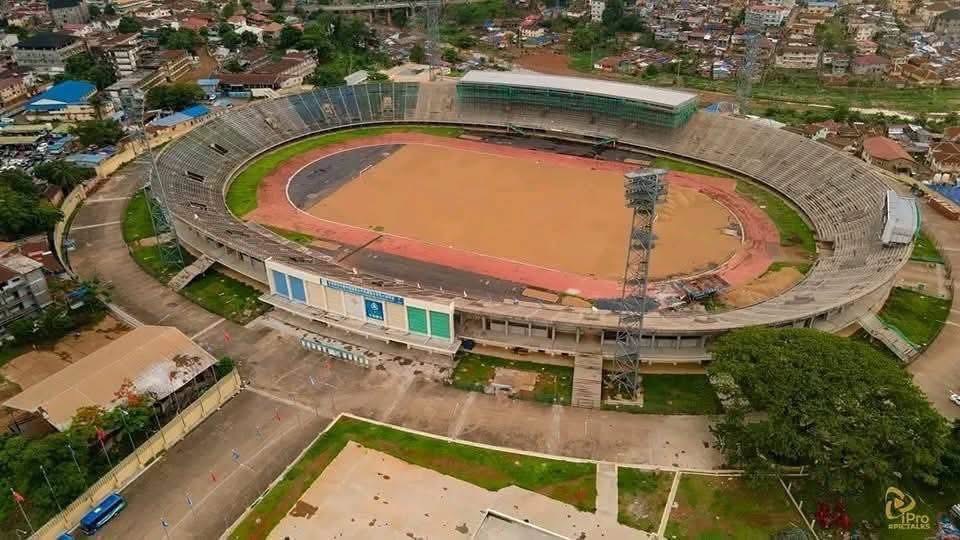
The stadium, which dates back to 1979, has historically been the home of Leone Stars and a major venue for football, athletics and other sporting activities.
Yet the facility has spent years largely unavailable for the country’s biggest sporting events.
By June 2026, Parliament’s Committee on Sports was sufficiently concerned about the delays to summon officials and demand explanations. Officials acknowledged that although several auxiliary facilities had been completed, work on the main stadium bowl remained unfinished. The National Sports Authority indicated that full completion could extend to late 2026 or early 2027.
In July, several facilities-including the stadium hostel, basketball court, practice field and swimming pool-were partially handed over, but construction was still continuing on the main stadium bowl.
So, more than four years after the project began, Sierra Leone still does not have the fully rehabilitated national stadium it was promised.
That is the problem.
Where Is the Accountability?
Government officials have cited logistical, technical and other challenges for the delays. There have also been reports of difficulties surrounding materials and the installation of stadium seating, including the need for approvals from Chinese authorities.
These explanations may be genuine. Major construction projects can encounter unforeseen difficulties.
But explanations do not eliminate accountability.
A competent project-management system should anticipate risks, manage variations, communicate revised deadlines and ensure that contractors and government agencies remain accountable for delivery.
What is difficult to accept is the repeated movement of completion dates without a clear, publicly communicated explanation of precisely what went wrong, what has been done to correct it and what guarantees exist that the latest deadline will be respected.
The national stadium is not merely a construction site. It is a national asset.
Its prolonged closure has had consequences beyond concrete, seats and floodlights. Sierra Leone has been forced to host important international football fixtures away from home, depriving supporters of the opportunity to watch Leone Stars on home soil and imposing additional costs on the country’s sporting system.
That should never become normal.
Then We Are Told About the Lungi Bridge
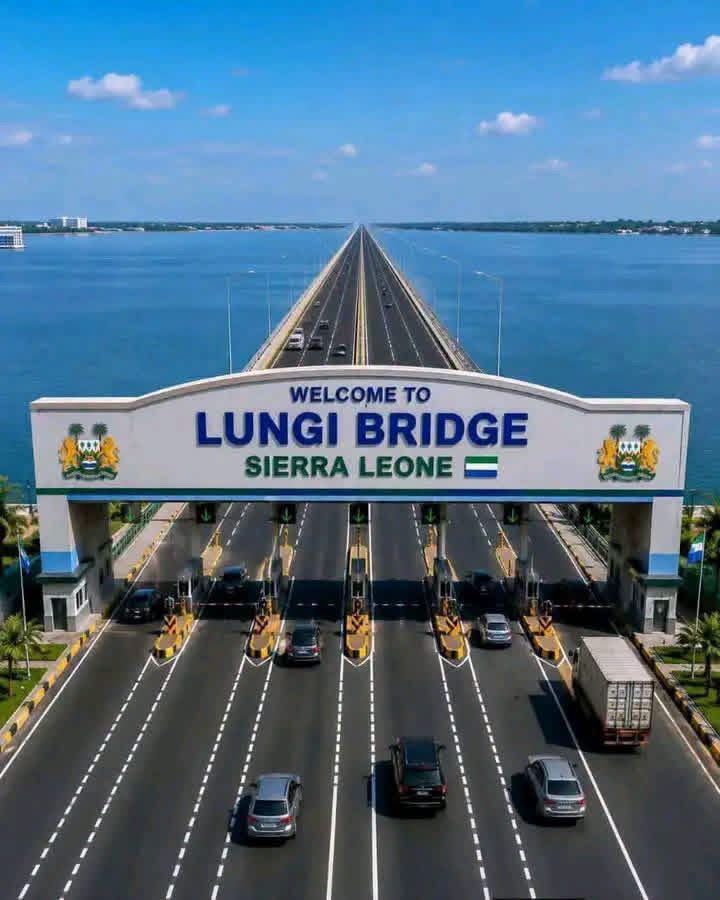
Now consider the scale of the proposed Freetown-Lungi Bridge.
The bridge is expected to provide a direct road connection between Freetown and Lungi, where the country’s international airport is located. The latest information indicates that the project has moved forward with an agreement involving Acrow Corporation, a United States-based infrastructure company.
According to recent reports, the proposed bridge would span approximately 7-8 kilometres, with an estimated cost of between US$1.15 billion and US$1.5 billion. Construction is projected to take between three and six years, although the actual start date remains tied to financing and other project-development arrangements.
That is a fundamentally different scale from the stadium rehabilitation.
At US$1.15 billion, the bridge would cost nearly 29 times the estimated US$40 million stadium project. At US$1.5 billion, it would be about 37.5 times the stadium’s estimated cost.
And that is precisely why Sierra Leoneans should be asking difficult questions now-not after billions of dollars have been committed.
If a US$40 million rehabilitation of an existing stadium, initially scheduled for two years, can stretch toward five years, what mechanisms will prevent a US$1.15-1.5 billion bridge from becoming another monument to delayed deadlines?
That is not an unreasonable question.
It is a necessary one.
The Lungi Bridge Must Not Become Another Political Promise
Let us be clear: Sierra Leone needs the Lungi Bridge.
The country’s dependence on ferries and the long road-and-water journey between Freetown and the airport has been a longstanding infrastructure challenge. A direct bridge connection could transform travel, logistics, tourism and investment.
The project could become one of the most consequential pieces of infrastructure in Sierra Leone’s modern history.
But ambition alone does not build bridges. Neither do press conferences. Neither do memoranda of understanding. Neither do groundbreaking ceremonies.
Projects are delivered through credible financing, sound engineering, competent project management, transparent procurement, effective supervision and strict adherence to timelines.
The government therefore has a responsibility to demonstrate that it has learned from the stadium experience before embarking on a project of this magnitude.
This Is Bigger Than the Stadium. The argument here is not that renovating a stadium is technically comparable to constructing a major bridge. It is not.
A bridge across the Sierra Leone River presents vastly more complex engineering, environmental, financial and logistical challenges than rehabilitating an existing stadium.
But that makes the stadium experience more relevant, not less.
The issue is institutional capacity.
Can government agencies effectively manage large contractors?
Can they resolve technical and administrative bottlenecks quickly?
Can they prevent scope changes from becoming endless delays?
Can they enforce contractual obligations?
Can they provide accurate and consistent completion dates?
Can they protect taxpayers and the public interest when projects encounter difficulties?
These are the questions that matter.
Sierra Leoneans Deserve More Than Promises.
There is nothing wrong with dreaming big.
President Julius Maada Bio’s administration has placed infrastructure prominently within its development agenda, and Sierra Leone needs ambitious infrastructure to unlock economic growth.
But the larger the project, the greater the responsibility to demonstrate competence.
The Lungi Bridge should therefore not be sold to the public merely as another transformational promise. Sierra Leoneans deserve to know exactly how it will be financed, what the final contractual arrangement entails, when construction will actually begin, what the definitive completion date is, what safeguards exist against cost overruns and delays, and who will be held accountable if the project falls behind schedule.
The public should not have to wait years for answers.
The stadium experience has already shown what happens when deadlines slip.
A project promised for two years is now entering its fifth year, with the main bowl still awaiting completion.
The government cannot reasonably expect citizens to look at that record and respond to a US$1.5 billion bridge proposal with unquestioning confidence.
Trust must be earned through delivery.
Do Not Build Another Monument to Delay
The Siaka Stevens National Stadium should be a lesson.
It should teach the government that infrastructure projects are not successful because they are announced. They are successful because they are completed, operational and delivered within a reasonable timeframe and at an accountable cost.
The Lungi Bridge represents a far greater challenge.
It is potentially a US$1.15–1.5 billion undertaking compared with the stadium’s approximately US$40 million rehabilitation. It involves a much larger financial commitment and substantially greater technical complexity.
So before Sierra Leone commits itself fully to this gigantic undertaking, the government must demonstrate that it has the institutional capacity to deliver it.
Otherwise, today’s ambitious bridge could become tomorrow’s national frustration.
If it takes a government more than five years to finish renovating a stadium that was supposed to take two, Sierra Leoneans are entitled to ask a simple question: why should we believe that a project nearly 30 to 38 times larger in financial scale will be completed on time?
The government should answer that question now.
Not with another promise.
With a plan. With transparency. With deadlines. And, ultimately, with results.


