

USL Rejects Key ACC Findings, Demands Public Apology Over Investigation Report
 Aaron Parker
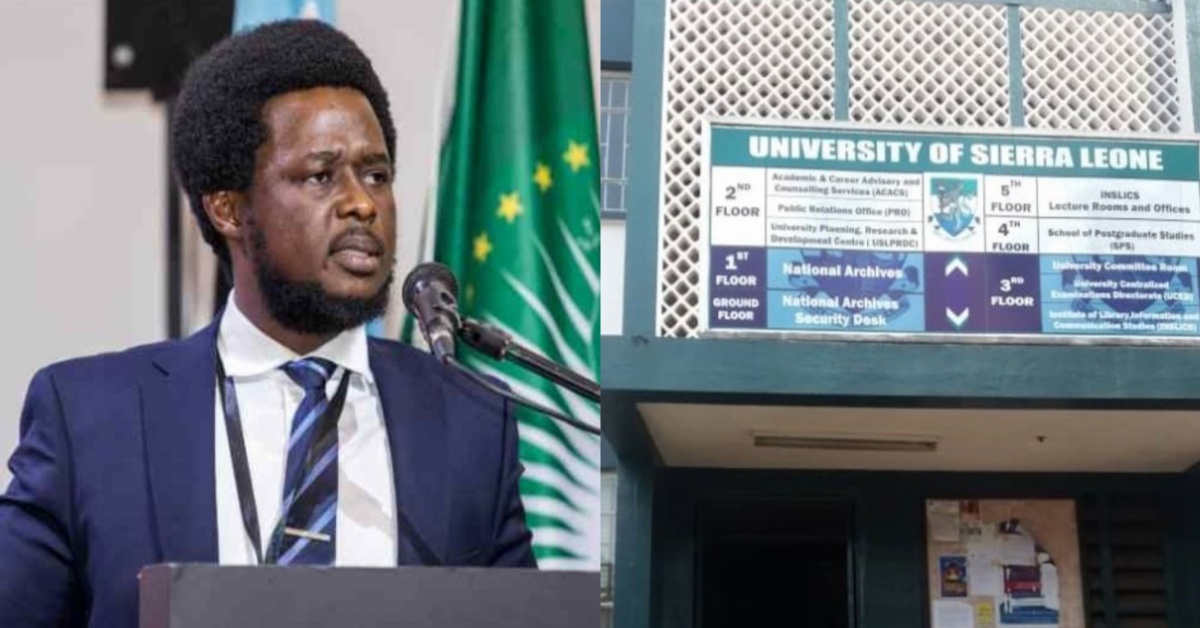
 The Management of the University of Sierra Leone (USL) has strongly rejected key aspects of a recent report by the Anti-Corruption Commission (ACC), while accepting some internal governance shortcomings and calling for corrective reforms across its administrative systems.
In a detailed nine-page position paper presented on Wednesday at Fourah Bay College, USL described parts of the ACC’s May 8 report as “factually inaccurate, legally misinterpreted, and procedurally flawed,” and demanded that the Commission direct its Director of Crimes, Mrs. Evelyn S. Kuyembeh, to issue a public apology and retract the report currently in circulation.
The university’s response was delivered by Dr. Tonya Musa, Director of Communications, in the presence of top USL leadership, including the Vice Chancellor and Principal, registrars, finance officials, and deputy vice chancellors from Fourah Bay College and COMAHS.

The ACC investigation stemmed from findings of USL’s own internal inquiry committees established in 2025, which examined administrative, financial, procurement, and governance practices between 2021 and 2023.

The ACC’s report raised concerns about alleged irregularities across multiple areas of university operations, prompting USL to conduct a comprehensive review through several subcommittees covering policy, finance, administration, and research governance.
USL firmly rejected the ACC’s interpretation of the departure of former Registrar Mrs. Olive K. Barrie and former Finance Director Mrs. Waltina Mackay, stating that both officials were placed on administrative leave in January 2024 after the expiration of their five-year contracts.
According to USL, neither official was dismissed for misconduct or corruption, and the ACC’s framing of their exit as punitive was “unsubstantiated and misleading.”
On the university’s Business Centre, USL acknowledged that while the entity operates outside the strict scope of the Public Procurement Act as a company limited by guarantee, significant governance concerns remain.
The university disclosed that its internal Policy Sub-Committee found the Business Centre had engaged in procurement activities beyond its mandate, including the purchase of vehicles, stationery, and IT equipment.
USL further noted that the National Public Procurement Authority (NPPA) had cautioned the institution as far back as 2021 over these practices.
The university warned that the dual role of the Business Centre as both supplier and procurement facilitator created a conflict of interest under Section 33(1)(c) of the Public Procurement Act 2016. It stated plans to either restructure the entity or bring it fully under procurement oversight.
USL accepted several procurement-related findings identified by its internal Policy Sub-Committee, including the absence of a functional procurement committee, lack of an internal procurement policy, weak record-keeping practices, and failure to establish an Independent Procurement Review Panel.
The university also confirmed that a vehicle purchase worth US$126,000 bypassed required international competitive bidding procedures.
Management said corrective measures are already underway.
The report also highlighted governance weaknesses in research funding oversight, including a lack of centralized coordination and inadequate monitoring of overhead payments.
USL raised concerns over alleged non-cooperation by the Deputy Vice Chancellor of COMAHS, Professor Mohamed Samai, regarding research grant data collection, suggesting tensions over control of research overhead expenditures.
The university further noted that its research coordination structures have been non-functional since 2018, contributing to fragmented oversight across faculties.
While USL accepted that a previously reported Le6.5 billion discrepancy had already been reviewed by both the Audit Service Sierra Leone and the ACC, it pointed to deeper systemic challenges inherited from prior administrations.
The institution cited instances where financial statements for 2021–2022 were not submitted on time, prompting audit concerns that affected the current leadership despite pre-dating its tenure.
Additional issues identified included delayed payment of retiree benefits, retention of unapproved staff, and weak student fee collection systems.
USL stressed that many of the issues raised were not isolated incidents but part of long-standing structural weaknesses.
Its internal subcommittees reportedly identified 17 additional governance gaps, including the absence of performance appraisal systems for academic staff, lack of attendance monitoring mechanisms, and the abandonment of key academic tenure policies since 2018.
The university argued that focusing solely on individual accountability without addressing institutional weaknesses presents an incomplete picture of its challenges.
In its concluding remarks, USL called on the ACC Commissioner to instruct the Director of Crimes to retract the report and issue a public apology, stating that the current version of the report damages the university’s reputation and undermines the credibility of internal investigative processes.
Despite its criticism, USL reaffirmed its commitment to implementing recommendations from multiple internal reports, including findings from INVCOM, RESCOM, and three policy-related subcommittees established in 2025.
The position paper was issued under the seal of the Office of the Registrar and formally signed by the Management of the University of Sierra Leone.