

Sierra Leone, South Korea Seal $5.6 Million K-Rice Belt Grant to Boost Rice Production
 Daniel Amara
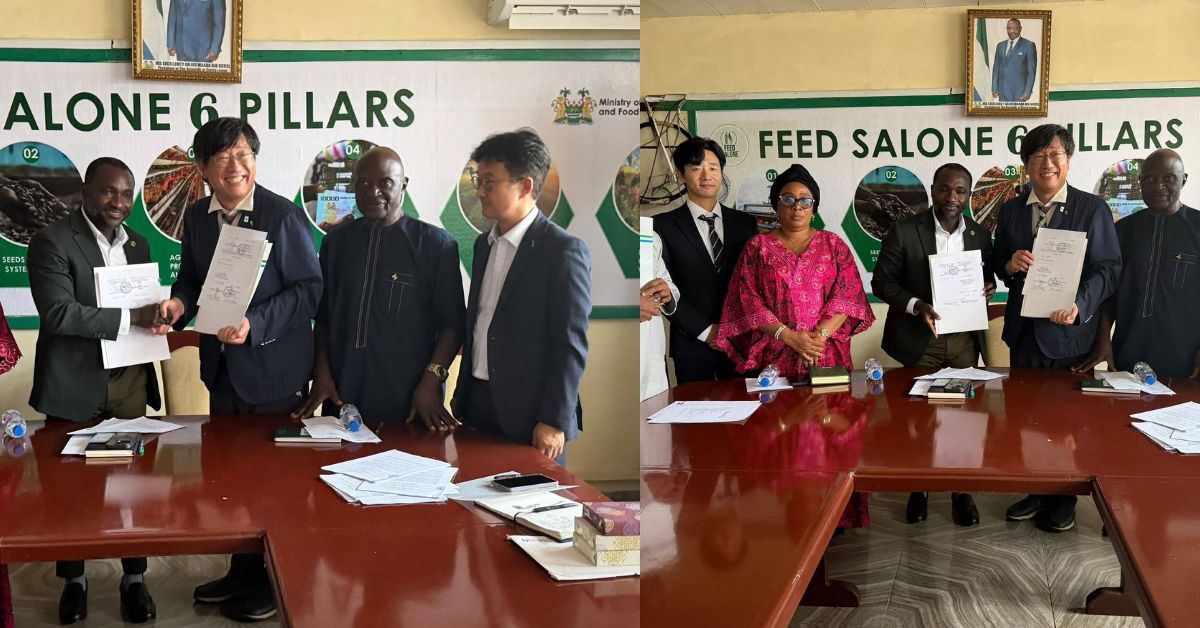
 The Government of Sierra Leone has signed a US$5.6 million grant agreement with the Republic of Korea to implement the K-Rice Belt Project, a major agricultural initiative aimed at increasing rice production and strengthening the country’s food security.
The Record of Discussions was signed by the Minister of Agriculture and Food Security, Dr Henry Musa Kpaka, and the Minister of Planning and Economic Development, Kenyeh Barlay, together with representatives of the Government of the Republic of Korea and its implementing institutions.
Speaking during the signing ceremony, Dr Kpaka said the project is designed to tackle key challenges affecting rice production across the country. He noted that the initiative will establish a modern rice seed production complex, improve irrigation and seed-processing infrastructure, provide agricultural machinery, and enhance the skills of farmers, researchers, and government personnel through capacity-building programmes.

Minister Kenyeh Barlay described the investment as a significant boost to the Government’s Feed Salone agenda, which seeks to achieve food self-sufficiency by increasing local agricultural production.

“We cannot reduce rice imports if we do not invest in the sector. The Government is deliberate in ensuring that we reduce rice imports and make rice affordable for everyone,” she stated.
The Development of Africa Rice Cultivation Complex (Sierra Leone) project will run for five years, from 2026 to 2030, and will be implemented in Rokupr, Kambia District. The initiative is fully funded through a US$5.6 million grant from the Government of the Republic of Korea.
The project aims to provide improved rice seed varieties, introduce modern rice production technologies, and deliver practical training to farmers. It is expected to increase rice yields, lower production costs, improve farmers’ incomes, and strengthen participation in Sierra Leone’s growing domestic rice value chain.
The agreement marks another milestone in the bilateral partnership between Sierra Leone and the Republic of Korea, while reinforcing the Government’s commitment to reducing dependence on imported rice and achieving sustainable food security.