

The Cells Are Full. The Courts Are Empty.
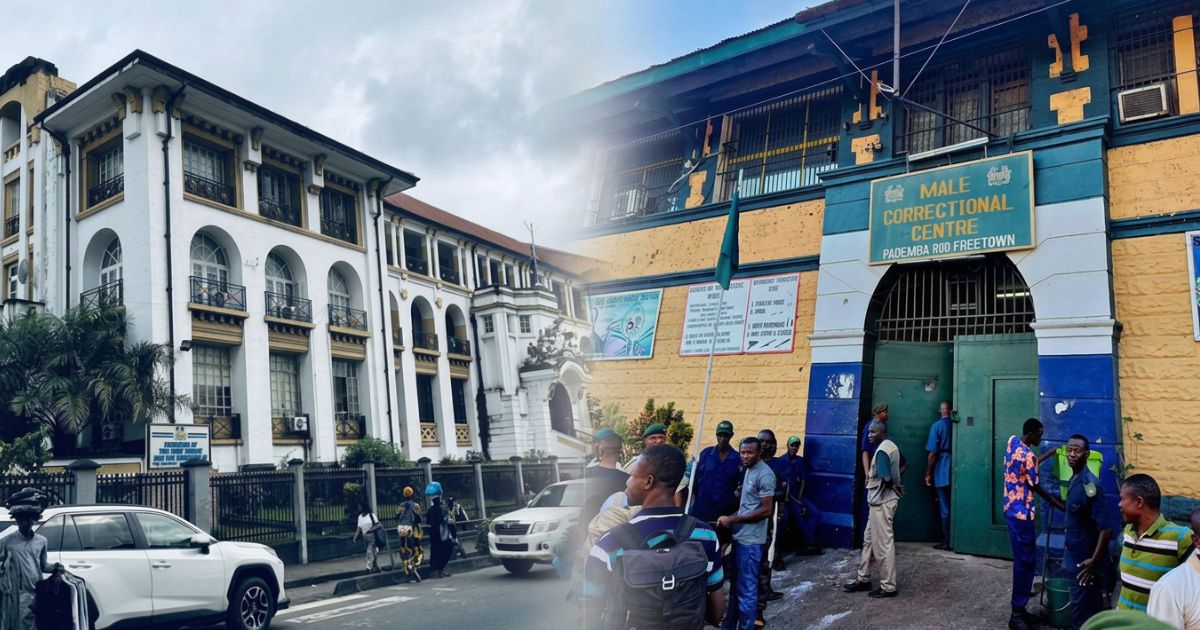
There is a man sitting in a cell at the Freetown male correctional facility tonight who has not been indicted.
He has been there for months. Possibly longer. The record does not say why.
The Campaign for Human Rights and Development International (CHRDI) visited the facility in February 2026 and found 385 males detained without indictment beyond legally permissible limits. Another 76 men — and 17 women — were held in what the authorities call “safe custody,” with no official reasons on file, their cases unregistered with the Transnational Organised Crime Unit (TOCU).

No charge. No indictment. No explanation.


That is not a cell. That is a room with a lock — and a state that has forgotten someone is inside.
The Numbers That Should Shame Us
The Freetown male correctional facility was built to hold 324 people. When CHRDI’s monitors walked in on 17 February 2026, 1,802 were inside. That is 556% of capacity. Some cells built for one person now hold thirteen.
-
Ninety-seven inmates are HIV-positive.
-
Twenty-six have tuberculosis.
-
The makeshift hospital has 16 beds for over 1,000 men.
-
The female facility — more than 200 women — has five beds and sometimes a single nurse on duty.
-
Eight children between zero and two years of age were found living with their incarcerated mothers.
-
One foreign national reportedly died in February 2026 under circumstances CHRDI said were not explained.
These are not abstractions. They are Sierra Leoneans — and they are there, in many cases, because the courts cannot move.
The Courts Cannot Move
CHRDI’s separate Court Monitoring Report, covering October and November 2025, documented 76 court sessions across Freetown’s courts. The picture was as grim as the prison data.
-
In one sitting, a judge adjourned ten cases in ten minutes because no one appeared — lawyers absent, litigants absent, state unready. CHRDI described it plainly: “Such practices trivialise court proceedings.”
-
Judges attended training sessions — a good thing in principle — without adequate notice to court users. Litigants travelled long distances to court, found the doors functionally closed, and went home.
-
Files have been stored in rice bags and plastic bags at the Pademba Road Magistrates’ Court because there is no digital system.
-
Printer ink ran out months ago; judgments could not be printed.
-
Court of Appeal judges are sitting on High Court matters because the High Court is overwhelmed, effectively shutting down the Court of Appeal.
-
The Commercial Court — built for speed — is described by CHRDI as “rendered redundant.”
And now, in May 2026, CHRDI has published fresh findings from police stations: 953 detainees assessed across 15 stations and posts in Freetown between 28 April and 7 May 2026. Widespread over-detention. Denial of legal representation. Serious procedural violations.
The detainees flowing from the streets into the cells are meeting a correctional system already at 556% capacity.
The cells fill. The courts stall. Nobody comes out.
The Law Is Not Ambiguous
The right to trial within a reasonable time is not a courtesy. It is a constitutional guarantee.
Section 23(1) of the Constitution of Sierra Leone 1991 provides that any person charged with a criminal offence shall be afforded a fair hearing within a reasonable time by an independent and impartial court established by law.
The Criminal Procedure Act further circumscribes how long a person can be detained without charge and without indictment. Those limits are being violated — not occasionally, not in edge cases, but systematically, at scale, documented by independent monitors, and reported to the public.
Prolonged pre-trial detention without indictment is not a bureaucratic failure. It is unlawful deprivation of liberty. The state cannot imprison a person it has not charged, tried, or convicted. When it does, every day of that detention is a breach of the person’s constitutional rights — no matter how full the facility, how empty the printer cartridge, or how busy the judge.
The Dysfunction Is Upstream
It is tempting to blame the prison service. The cells are overcrowded — fix the cells. But that is not where the problem begins.
-
It begins in a court that adjourns ten cases in ten minutes.
-
It begins with a case file stored in a rice bag.
-
It begins when a judge cannot print a judgment because the court ran out of ink three months ago.
-
It begins when appeal judges are pulled downward to handle trial matters, leaving the appellate tier vacant above them.
-
It begins — and this demands saying directly — when active case files are taken from judges mid-hearing and reassigned without notice to the parties, resetting everything to zero. CHRDI documented at least five such instances. The organisation called it forum shopping. The law calls it an abuse of process.
The man in the cell is downstream of all of this. He arrived because a court could not hear him quickly enough. He stays because the system upstream has no pressure to move. And he sits there — uncharged, unindicted, unexplained — while the facility fills around him to 556% of its design.
What Accountability Requires
Abdul M. Fatoma of CHRDI said it directly:
“No nation can claim progress if its correctional facilities remain centres of human degradation. Justice must be more than a legislative promise; it must be a functional reality for every Sierra Leonean.”
He is right. But functional justice requires more than exhortation.
-
It requires fast-tracking indictments for those detained beyond permissible limits — not next quarter, immediately. The law requires it. The Constitution requires it.
-
It requires the Legal Aid Board to deploy representation to every person in pre-trial detention without a lawyer — not as a target, as a legal obligation. Section 23(2)(d) of the Constitution guarantees legal assistance. That guarantee is meaningless if no one enforces it.
-
It requires the Chief Justice to direct courts to report monthly on cases adjourned more than three times without substantive hearing — and to explain why. Judicial independence does not mean judicial invisibility.
-
It requires Parliament — the institution constitutionally mandated to hold the executive and judiciary accountable — to receive these CHRDI reports and demand written responses from the Minister of Justice and the Judiciary within thirty days. That is not overreach. That is oversight. That is the legislature’s job.
-
And it requires every member of the legal profession — every silk, every managing partner, every junior at the Bar — to acknowledge what these reports confirm: the system over which we preside is producing mass unlawful detention as a structural output. Not as an anomaly. As a routine.
The Standard We Must Hold
Sierra Leone’s courts have, when properly resourced and properly committed, produced principled judgments. The High Court has upheld rights. The Court of Appeal has overturned injustice. The system is not irredeemable. But a system cannot be both principled and indifferent to the conditions in which it operates — and right now, the operating conditions are catastrophic.
The cells are full of people the courts have not processed.
The courts are full of adjournments, absent parties, empty cartridges, and reassigned files.
The overlap between those two facts is not a coincidence. It is a policy failure wearing the mask of administrative difficulty.
A nation is judged not by what its Constitution says, but by what its cells contain. Sierra Leone’s cells contain uncharged men and women, children born to incarcerated mothers, and the dying — held together in a space built for a fraction of their number, waiting for a system that has not found the urgency to move.
That must end. The law says it must. The Constitution demands it.
Every Sierra Leonean who believes in the rule of law should say it — loudly, without equivocation.
The rule of law is the rule of law.