Post a comment
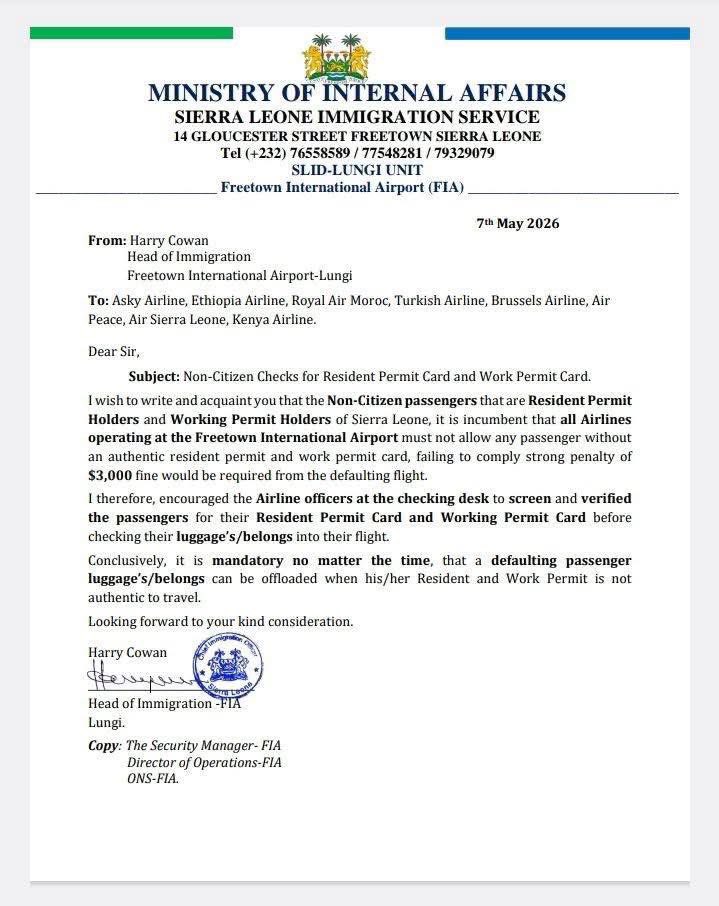
The Sierra Leone Immigration Department has issued a directive to all international airlines operating at Freetown International Airport in Lungi, mandating that no non-citizen passenger holding a Resident Permit or Work Permit be allowed to board a flight without producing valid documentation, effective immediately.
In a letter dated May 7, 2026, signed by Harry Cowan, Head of Immigration at Freetown International Airport, the department warned that any airline found in default would be required to pay a $3,000 fine.
“It is incumbent that all airlines operating at the Freetown International Airport must not allow any passenger without the relevant permit to board,” Cowan wrote. “A $3,000 fine would be required from the defaulting flight.”

The directive applies to all major carriers serving the airport, including Asky Airline, Ethiopian Airlines, Royal Air Maroc, Turkish Airlines, Brussels Airlines, Air Peace, Air Sierra Leone, and Kenya Airways.
Cowan encouraged airline officers at checking desks to screen and verify passengers’ Resident Permit Cards and Work Permit Cards before checking luggage or allowing passengers to board.
“Conclusively, it is mandatory, no matter the time, that a defaulting passenger’s luggage can be offloaded when his/her Resident and Work Permit is not authentic to travel,” the directive stated.
Copies of the order were sent to the Security Manager at Freetown International Airport, the Director of Operations of the Immigration Department, and the Office of National Security at the airport.
The May 7 directive follows a series of government measures in recent months aimed at tightening immigration compliance and establishing a comprehensive database of foreign nationals in Sierra Leone.
On April 7, 2026, the Government of Sierra Leone, through the Ministry of Employment, Labour and Social Security and the Sierra Leone Immigration Department, confirmed that effective April 1, 2026, biometric residence and work permit cards are the only legally recognized documents for non-nationals living and working in the country .
All previous paper-based permits have been declared invalid for identification, residency, or employment purposes. The government had granted an initial 45-day transition period beginning January 2026, later extended by one month, to allow non-nationals to replace their old paper permits with new biometric cards .
Since mid-April 2026, authorities have begun nationwide enforcement of mandatory registration requirements for all foreign nationals residing and working in Sierra Leone . The enforcement covers compliance with Non-National Identity Cards, Residence Permits and Work Permits.
Officials have stated that the initiative is aimed at strengthening national security systems through the development of a comprehensive foreign nationals database for effective monitoring and compliance . All non-citizens are required to obtain the relevant documentation and keep them in their possession at all times.
The new biometric permit system is part of a broader modernization effort. Since January 1, 2026, all Resident and Work Permit applications and renewals have been processed exclusively online through the government’s Unified Digital Platform at www.unifiedpermit.gov.sl.
The government has described the platform as providing a “secure, transparent and fully integrated end-to-end process,” allowing applicants to submit applications, track their status, and receive approvals remotely.
Application and verification offices have also been made operational in Freetown, Bo, Kenema, Makeni, Kono, and Port Loko to assist with the transition
Authorities have warned that failure to comply with the new requirements may result in denial of entry or exit at borders, administrative sanctions and penalties and revocation of residency or work authorization.
Employers have also been reminded of their legal obligation to verify the status of all non-national employees, with violations subject to penalties under national regulations .
The government has emphasized that no further extensions will be granted, urging all non-nationals and employers to regularize their status immediately.
The Chinese Embassy in Sierra Leone has issued a consular notice advising Chinese citizens residing and working in the country to strictly comply with the new registration requirements and carry valid documents at all times.
The embassy urged Chinese nationals to carry their Non-National ID cards, residence permits, or work permits while outside their homes, warning that failure to do so could result in enforcement actions.
In February 2026, the National Civil Registration Authority (NCRA) announced increased fees for national identification cards, citing fluctuating currency exchange rates and rising global production costs. The cost of the mandatory Non-National ID Card for foreign residents jumped from SLL 2,005 to SLL 2,305.