NPRA Releases Updated Safety Guidelines Amid Ongoing Ban on Fuel Station Construction
 Sia Lucy Kannah
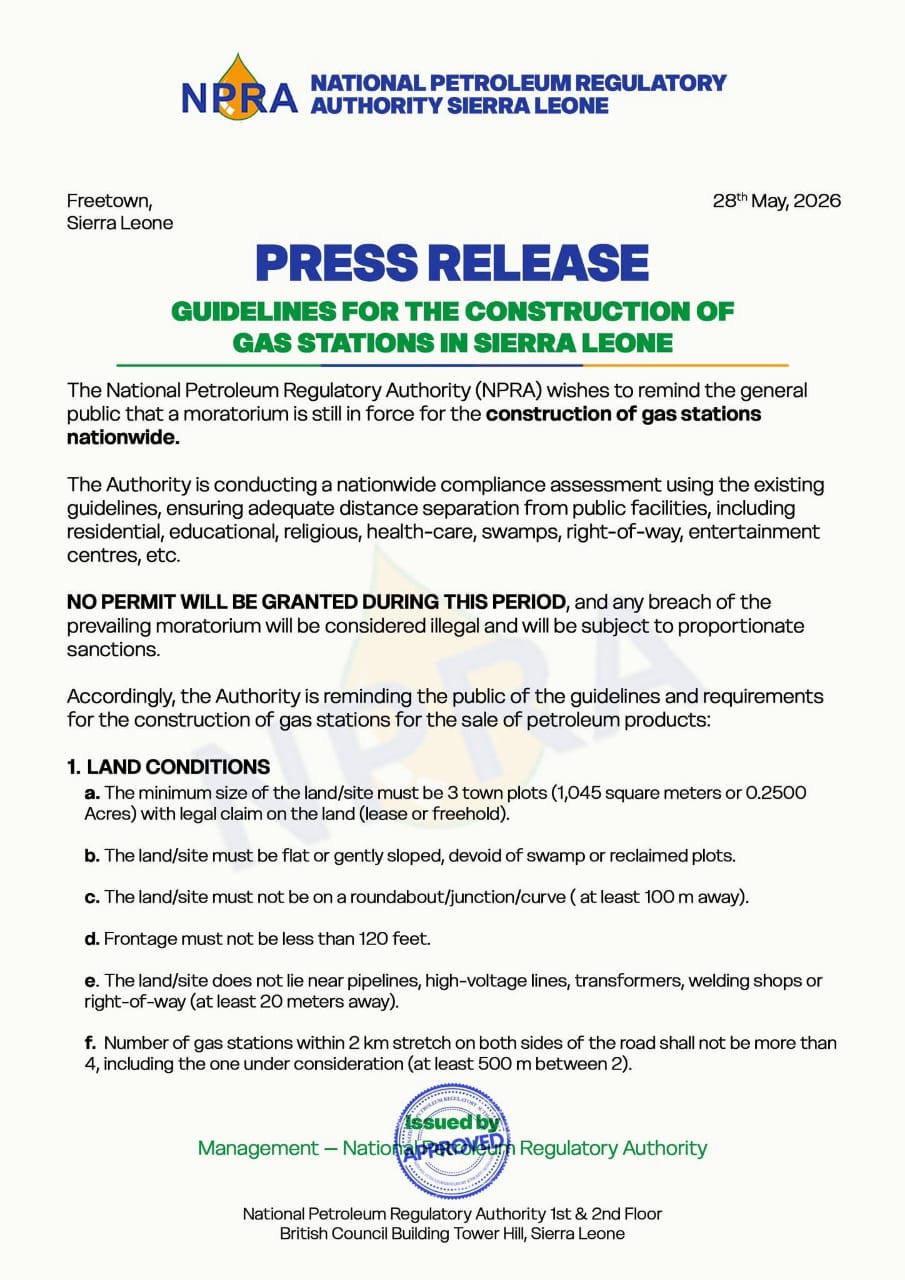
 The National Petroleum Regulatory Authority (National Petroleum Regulatory Authority) has issued a strong public notice reaffirming that the nationwide moratorium on the construction of fuel filling and gas stations remains fully in force across Sierra Leone.
In a press release dated 28th May 2026 in Freetown, the Authority stated that it is currently conducting a nationwide compliance assessment based on existing safety and siting standards. The review focuses on ensuring strict adherence to regulations governing the safe distance between petroleum facilities and public infrastructure such as residential areas, schools, health facilities, religious buildings, entertainment centres, wetlands, and road rights-of-way.
The NPRA emphasized that no permits will be granted during the moratorium period, warning that any attempt to construct or operate a fuel station in violation of the directive will be treated as illegal and subject to proportionate sanctions.

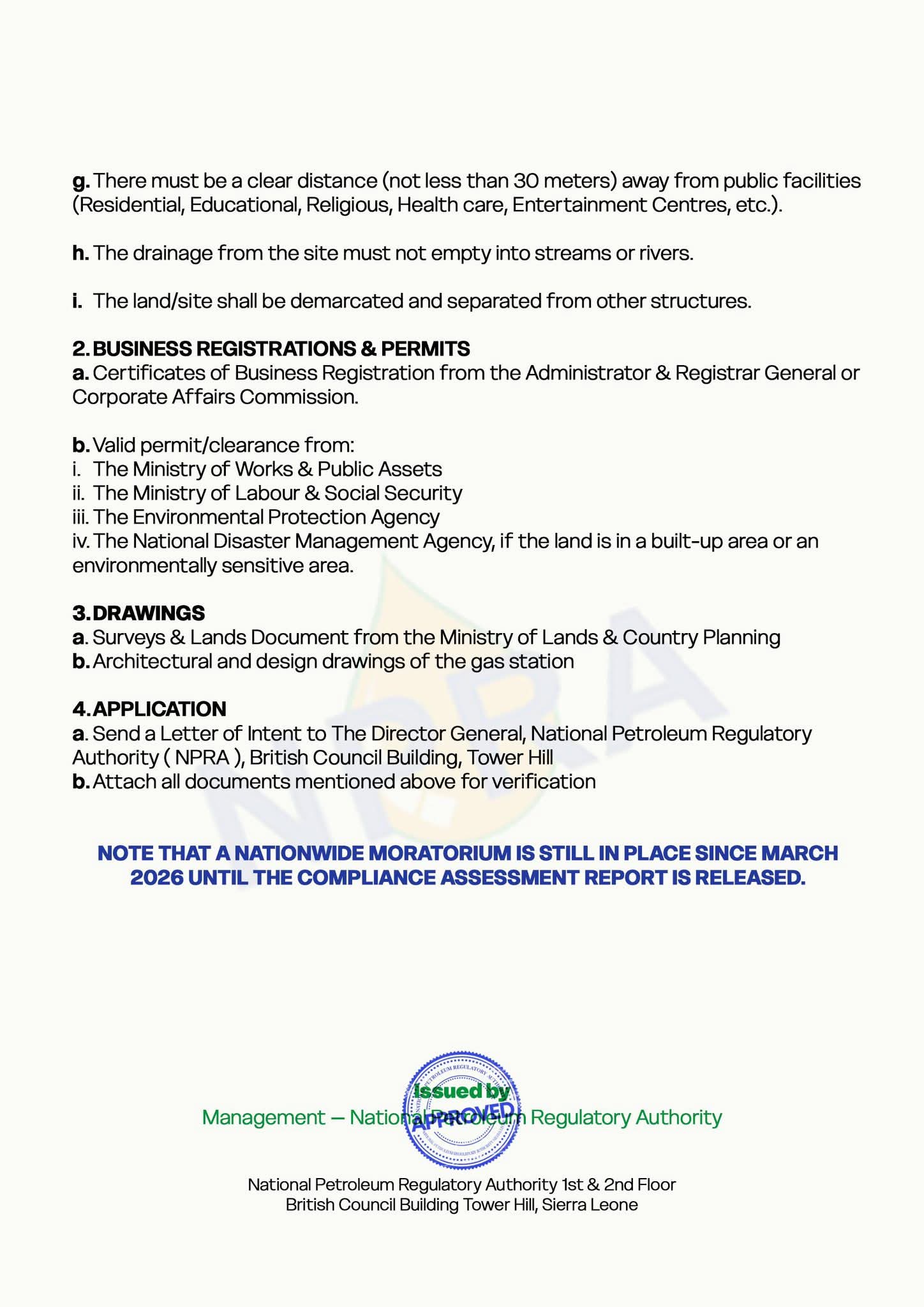
The Authority explained that the moratorium, which has been in place since March 2026, will remain effective until the completion and publication of the ongoing compliance assessment report.



STRICT GUIDELINES FOR GAS STATION CONSTRUCTION
Reiterating its regulatory framework, the NPRA outlined key requirements that must be met for any future approval once the moratorium is lifted.
1. Land Conditions
According to the guidelines, prospective sites must meet the following criteria:
A minimum land size of three town plots (1,045 square meters or 0.2500 acres) with valid legal ownership or lease documentation.
The site must be flat or gently sloped and must not be located on swampy or reclaimed land.
No station shall be sited on roundabouts, junctions, or road curves, with a minimum setback of 100 meters.
A minimum frontage of 120 feet is required.
The site must be at least 20 meters away from pipelines, high-voltage lines, transformers, welding shops, and road rights-of-way.
A minimum spacing requirement ensures that no more than four fuel stations exist within a 2-kilometre stretch of road, with at least 500 meters between stations.
A buffer distance of not less than 30 meters must be maintained from residential, educational, religious, healthcare, and entertainment facilities.
Drainage systems must not discharge into rivers or streams.
The site must be clearly demarcated and separated from surrounding structures.
2. Business Registration and Permits
Applicants are required to obtain:
Certificate of business registration from the Administrator and Registrar General or Corporate Affairs Commission.
Valid clearances from relevant institutions including:
Ministry of Works and Public Assets
Ministry of Labour and Social Security
Environmental Protection Agency
National Disaster Management Agency (mandatory where sites are located in built-up or environmentally sensitive areas)
3. Technical Drawings and Documentation
Applicants must also submit:
Survey and land documentation from the Ministry of Lands and Country Planning
Architectural and engineering design drawings of the proposed station
4. Application Procedure
All applications must be formally submitted through a Letter of Intent addressed to the Director General of the NPRA at the British Council Building, Tower Hill, Freetown, accompanied by all required documents for verification.
PUBLIC WARNING AND COMPLIANCE STANCE
The NPRA reiterated that the ongoing moratorium is a critical regulatory measure aimed at ensuring public safety, environmental protection, and proper urban planning in the petroleum retail sector.
It further cautioned that strict enforcement actions will be taken against any individual or company that disregards the directive or attempts to bypass the approval process during the suspension period.
The Authority reaffirmed its commitment to ensuring that future fuel station developments across Sierra Leone meet internationally acceptable safety and environmental standards.