

Geres Launches Rural Clean Energy Project to Power Businesses in Sierra Leone
 Aminata Koroma
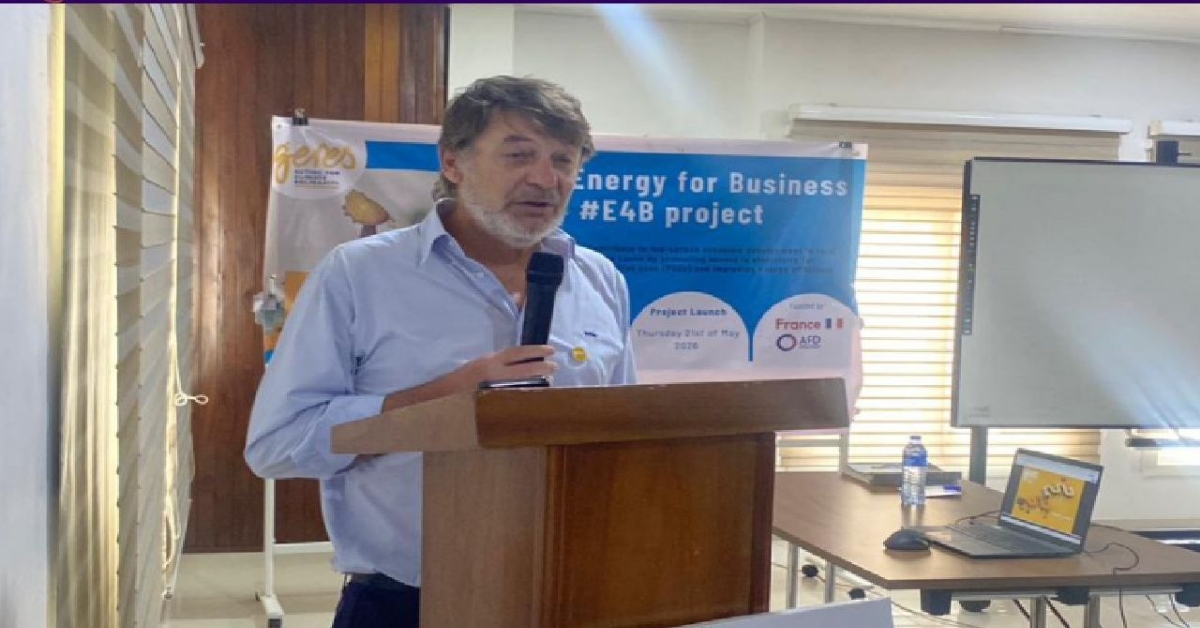
 French international non-governmental organization Geres has launched a major rural energy initiative in Sierra Leone aimed at expanding access to clean and sustainable electricity for small businesses and cooperatives in underserved communities.
The four-year project, known as Energy for Business (E4B), is funded by France and focuses on unlocking the productive potential of rural communities through renewable energy access. The initiative specifically targets women and youth entrepreneurs who currently operate without reliable electricity.
Speaking at the project launch, Philippe Labbé Lavigne, Country Representative and Project Manager for Geres, said the initiative seeks to transform rural economies by providing energy solutions designed for productive use.

“The overall ambition is to unlock the productive potential of rural Sierra Leone through inclusive access to clean and sustainable energy,” Labbé Lavigne stated. “We’re providing renewable energy specifically for productive users in rural areas where there is no energy access today and no plan for it in the near future.”

According to Geres, the pilot phase of the project will be implemented in five communities and 25 groups and cooperatives. The initiative aims to directly support 75 businesses while impacting nearly 5,000 households, representing approximately 30,000 people.
As part of the project, Geres plans to establish two new Energy Business Areas (EBAs), which are dedicated hubs where between 10 and 15 rural enterprises will be grouped and supplied with 24-hour solar electricity. Each EBA is expected to generate between 25 and 35 kilowatts of solar power, supported by backup generators to ensure reliability.
“We’re building these EBAs from scratch in areas with zero energy access,” Labbé Lavigne explained, adding that the model was previously tested in Mali.
The organization also plans to upgrade an existing mini-grid site into a hybrid EBA and distribute 25 standalone solar kits to rural entrepreneurs and cooperatives. While the project prioritizes agribusinesses, Geres said other productive sectors such as carpentry, tailoring, and bakeries will also benefit.
To expand productive energy use, Geres will collaborate with mini-grid operators including Power Leone, Noa, and PowerGen in selected mini-grid communities.
The organization said businesses benefiting from the project will receive more than electricity support. According to Labbé Lavigne, entrepreneurs will undergo tailored business training, coaching, and technical support for a full year.
“We’re not just dropping off solar panels,” he stressed. “Each business gets tailored training, coaching, and business support over a full year, with a strong focus on women and youth entrepreneurs.”
For farming and fishing groups, Geres will provide smaller solar systems of about six kilowatts capable of operating two to three machines simultaneously. The systems are expected to support activities such as food preservation, drying, and agricultural processing in order to reduce post-harvest losses and improve production.
The NGO said the project also seeks to strengthen long-term community ownership and sustainability. Under the initiative, Geres will introduce a public-private partnership model involving local communities and authorities.
“As the implementing company, we’ll manage operations and maintenance for both the solar systems and the buildings,” Labbé Lavigne said. “But the goal is community ownership. We’re building local capacity so these EBAs run long after the project ends.”
He added that energy access alone would not be sufficient without skills development and business support.
“Energy alone isn’t enough,” he said. “You need skills to use it productively. That’s how you transform daily life and local economies.”
The E4B project team, recruited between late 2025 and early 2026, has already completed territorial assessments in several rural communities. Geres said site selection is based on economic potential, population size, lack of planned electricity access, and community commitment.
According to the project team, four communities have already been shortlisted for detailed technical, social, environmental, and economic feasibility studies, after which two final pilot communities will be selected.
“Throughout all stages, community participation is central,” the E4B team stated. “The motivation and commitment of local people are key criteria.”
Government officials attending the launch welcomed the initiative and described it as consistent with Sierra Leone’s national development priorities.
Pamela Koneh of the Ministry of Planning and Economic Development (MoPED) said the project aligns with the government’s Medium-Term National Development goals.
“Energy is central in that agenda, and without reliable, affordable, and clean energy, we cannot drive productivity, create jobs, or uplift the rural community out of poverty,” she stated.
Antonin Coeur Bizot, Director of the French Development Agency for Guinea and Sierra Leone, also praised the project, noting that sustainable energy remains critical to economic growth and entrepreneurship.
“Access to reliable, affordable, and sustainable energy is the key condition for development,” Bizot said. “This is particularly true for Sierra Leone.”
Geres said feasibility studies are currently ongoing in Bo, Moyamba, and Kambia Districts, with the first pilot phase expected to begin in two selected communities. The organization added that the project, which will run until 2028, could later expand to other underserved areas across Sierra Leone.