

Music And Politics in Sierra Leone: Is Emmerson Bockarie a Lone Voice on Governance and Accountability?
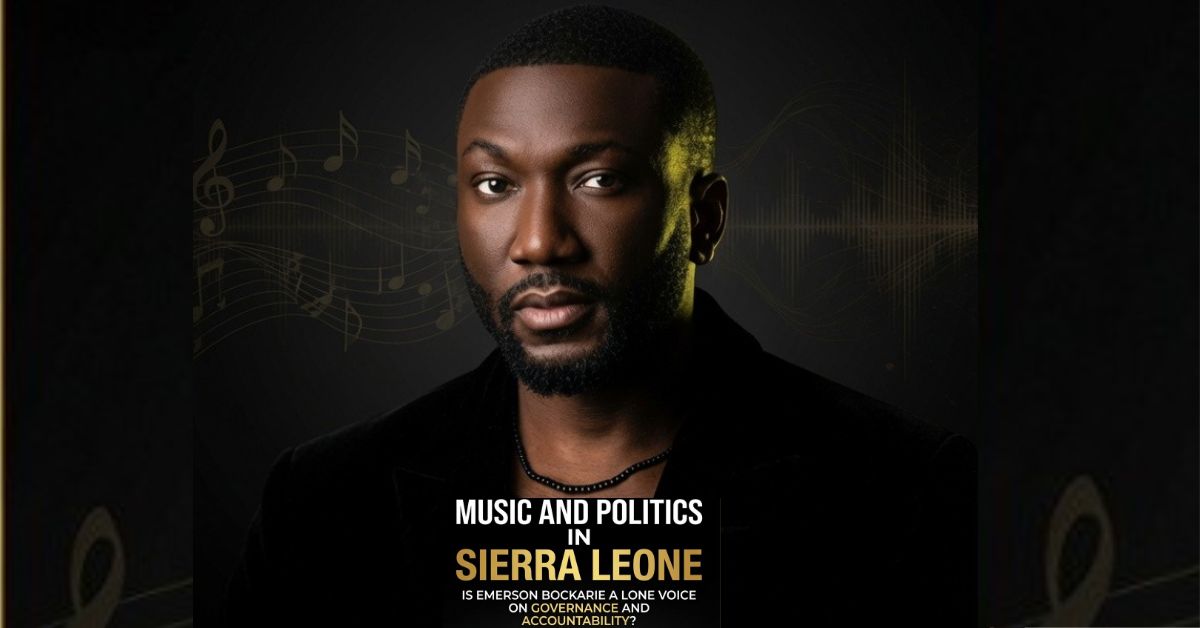
Since 2003, music has played a significant role in shaping citizens’ perceptions of politics and governance in Sierra Leone. In the years following the end of the country’s brutal 11-year civil war, music became a powerful tool for social commentary, civic engagement, and political accountability.
Sierra Leone’s post-war generation was filled with young citizens who were eager to see their country transformed and repositioned on the global stage. Just two years after the declaration of “War Don Don” in 2002, signalling the official end of the conflict, a new wave of musicians emerged, using their platforms to address governance issues and advocate for change.
The late President Dr. Ahmed Tejan Kabbah, who served as President of the Republic of Sierra Leone from 1996 to 2007, is often credited with creating an environment that allowed young artistes to freely express their views on national issues. During his administration, several musicians rose to prominence as vocal critics of corruption, poor governance, and social injustice.

Among them was Daddy Saj, whose music boldly highlighted corruption within state institutions. The Bow-Wow Society and Pupa Bajah also gained widespread recognition for their socially conscious music. One of their most notable songs, “City Life,” painted a vivid picture of the daily struggles faced by residents of Freetown.

The song highlighted the challenges confronting the capital city, including inadequate housing, unreliable electricity supply, poor healthcare services, sanitation concerns, and limited access to safe pipe-borne water. Among the many artistes who came forward to lend their voices to national discourse, Emmerson Bockarie, famed for his groundbreaking Borbor Bele album released in 2004, stood out as the most prominent.
The album, which featured about 12 tracks, was largely centered on themes of social justice, accountability, and political reform. Many of the songs advocated for social change and highlighted the challenges facing ordinary Sierra Leoneans.
This earned Emmerson recognition both at home and abroad for his bold political commentary, particularly on issues of corruption and governance. He was regarded as a unique artiste because of his consistency, courage, and ability to communicate effectively in both Krio and English, giving his message a wider reach across different audiences.
Emmerson was also widely perceived as an intellectual musician, partly because he was a student at Njala University when Borbor Bele was released. Consequently, his music—alongside that of other socially conscious artistes—gave voice to the frustrations and aspirations of ordinary Sierra Leoneans, reinforcing the role of music as an important instrument for public accountability and national discourse.
Fast forward to 2007, when a new government was elected under former President Ernest Bai Koroma, who governed the country until 2018. While there was little evidence of systematic restrictions on artistic expression during his administration, relatively few musicians openly criticized the shortcomings of the government through their music. Emmerson remained one of the notable exceptions, continuing to address governance issues and societal concerns through his songs.
Shortly after President Koroma was declared the winner of the 2007 presidential election by Dr. Christiana Thorpe, then Chief Electoral Commissioner of the National Electoral Commission (NEC), the country’s political landscape entered a new phase, one that would continue to test the relationship between music, governance, and public accountability.
Emmerson welcomed President Koroma with a song titled “Ef Ina Shake Wi Go Wap” and later released several albums, including Yesterday Beteh Pass Tiday (2010), Rise (2012), Kokobeh (2013), Home and Away (2014), and Survivor (2016), which featured the popular song “Muku Bus Pan Matches.”
During this period, he remained one of the few musicians consistently using music to comment on governance and social issues, even as many other artists gained opportunities to travel and perform overseas through various means. These albums further strengthened his public profile, earning him greater confidence, respect, and recognition among Sierra Leoneans.
In 2018, the government of President Julius Maada Bio and the SLPP took over from the APC administration. The new government’s flagship agenda was education, which led to the introduction of the Free Quality School Education Programme. During this period, Emmerson and several other prominent musicians were contracted to produce songs promoting the initiative and encouraging public support for the programme.
In 2020, Emmerson released the Coconut Ed album. In this project, he spoke about what he perceived as the continued mistreatment of ordinary Sierra Leoneans by both the SLPP and APC governments. This sentiment was captured in the song “Ani Wan We Kam Dae Turn-Turn Wi, Den No Sai Wi Na Coconut Ed.”
Following the release of the album, controversy quickly emerged. Emmerson faced public criticism from sections of the population, including fellow musicians. One notable reaction came from King Boss LAJ, who took to social media to condemn Emmerson’s position as expressed in the song. Critics argued that while Emmerson was willing to assign blame to previous governments, he appeared less critical of the current administration despite its own shortcomings.
Consequently, the album did not achieve the level of public reception many had anticipated. Streaming numbers reportedly fell below expectations, his fan base appeared increasingly divided, and only a few media houses were willing to give significant airtime to some of the album’s more critical tracks.
According to recent reports, Emmerson appears to have found the public reaction to his political commentary unfair and unappreciative of his contributions over the years. It is rumored that he is considering stepping away from political and social commentary in his music after facing criticism and accusations of bias from sections of the public.
No further political songs centered on social change are expected from Emmerson. Other school of thoughts accuse him for being a sell out to the country. In a recent video circulating on social media, he appealed to the public to leave him alone, stating that he is now focused on singing about life, money, and things that bring him happiness. “As for me, if una need pesin for sing about wetin Salone dae go through, una find oda artistes. As for me, count me out,” Emmerson remarked.
His comments have generated widespread reactions, with many people expressing disappointment and criticizing his position.
Given the background highlighted above, an important question arises: Is Emmerson Bockarie the lone voice on governance, accountability, and social justice in Sierra Leone, or are there not other artistes who have also consistently used music as a platform for advocacy and national consciousness?