

China Medical Team Delivers First Public Academic Lecture at Njala University
 Aminata Koroma
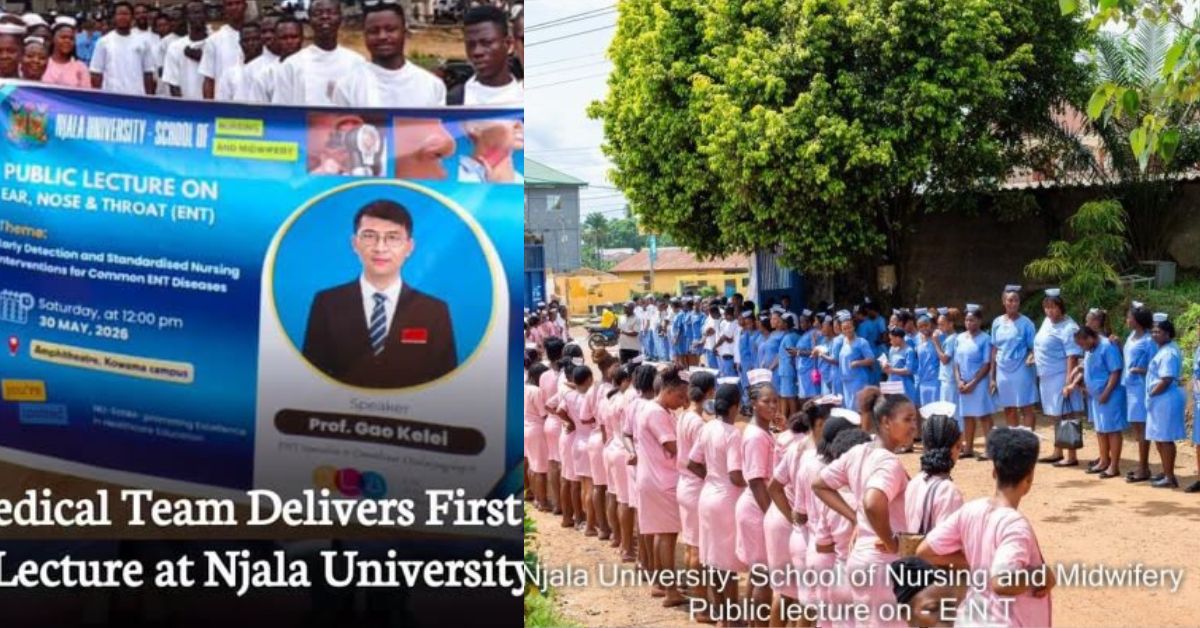
 The 27th China Medical Team (CMT) has delivered its inaugural public academic lecture to nursing students at Njala University, marking a significant shift from purely clinical outreach to structured medical education and knowledge transfer.
The lecture was held at the College of Medical Sciences’ School of Nursing and Midwifery and attracted hundreds of nursing students, faculty members, and senior health officials, creating a highly interactive academic environment. The session was led by Dr. Gao Kelei, an Otorhinolaryngology (ENT) specialist with the 27th CMT, following an invitation coordinated by Dr. (Mrs.) Angella M. George, Acting Dean of the School.
Beyond its academic content, the event underscored a broader strategic objective. The training focused on the early detection and standardised nursing interventions for common ENT conditions, areas considered critical to strengthening primary healthcare delivery in Sierra Leone. Dr. Gao simplified complex anatomical and clinical concepts into practical, step-by-step approaches tailored to resource-limited settings, where nurses often serve as the first point of patient contact.

The session quickly evolved from a traditional lecture into a dynamic learning experience. Students actively participated in case-based discussions and clinical simulations, tackling real-world scenarios such as airway obstruction, paediatric foreign-body emergencies, and infection-control protocols. Participants described the atmosphere as highly engaging and practical, reflecting a growing demand among emerging health professionals for hands-on, applied medical training.

The success of the lecture has already prompted discussions on expanding collaboration between the Chinese medical team and Njala University. Following the lecture, Dr. Gao and Dr. Angella M. George explored the possibility of establishing a structured partnership. Proposed areas of cooperation include regular public medical lectures, supervised clinical placements for nursing students at the Sierra Leone-China Friendship Hospital, and enhanced community-based medical outreach programmes.
For the 27th China Medical Team, the initiative signals an important evolution in its mission in Sierra Leone. While direct patient care and outreach remain central, the increasing emphasis on training and capacity building reflects a broader vision of strengthening the national healthcare system by investing in its future workforce.
If sustained, the Njala University lecture series could mark the beginning of a long-term academic bridge between Chinese medical specialists and Sierra Leone’s health education sector—one built not only on treatment, but also on teaching, mentorship, and the exchange of clinical knowledge.
Overall, the article is strong and reads more like a feature news report than a standard news story. For publication, I would rate it 8.5/10, with the main improvement being a stronger news-focused lead that emphasizes why the lecture matters to healthcare training in Sierra Leone.