Bank of Sierra Leone Raises Monetary Policy Rate to 17% Over Rising Inflation
 Bernice Bangura
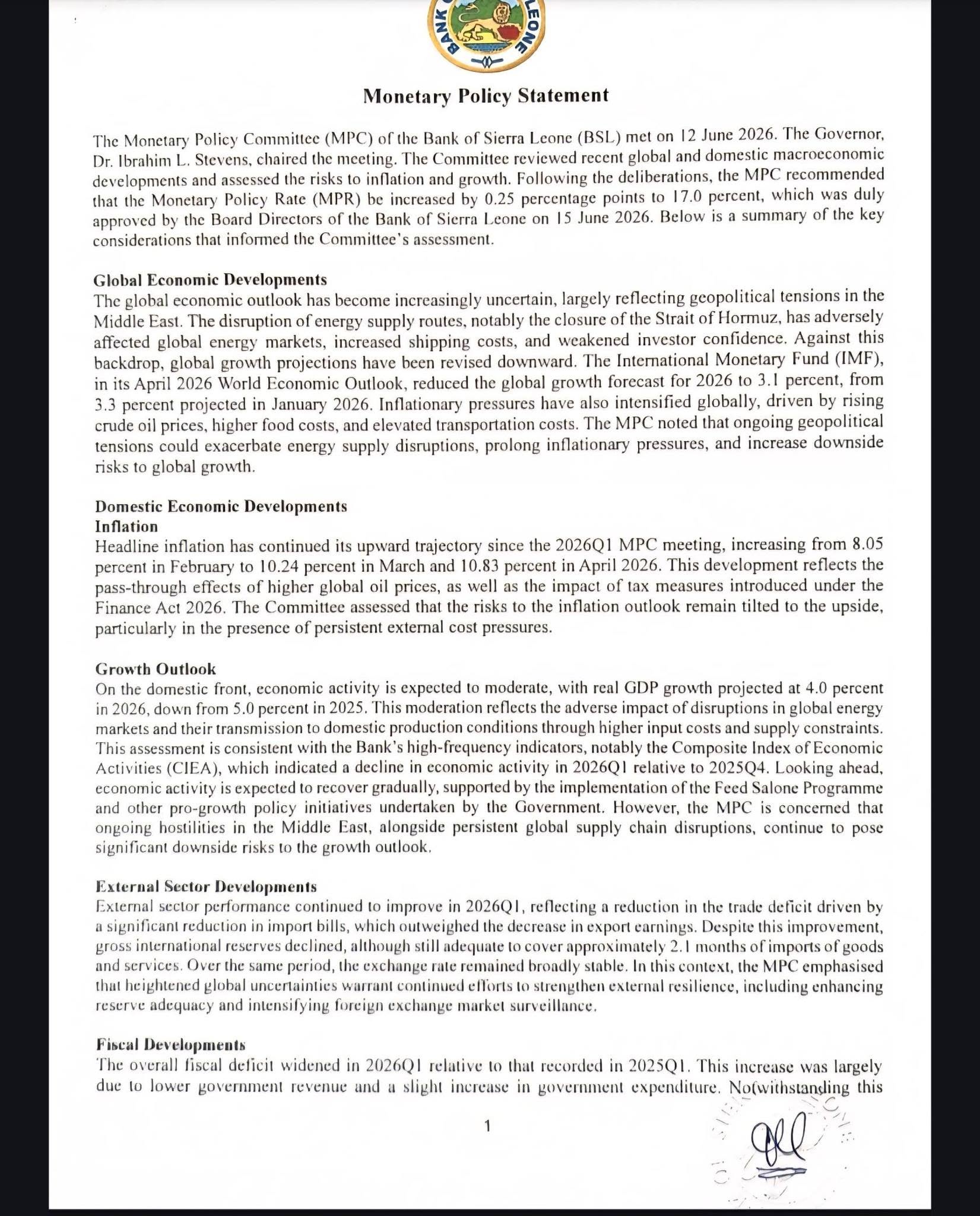
 The Bank of Sierra Leone has increased its Monetary Policy Rate (MPR) by 0.25 percentage points to 17.0 percent, citing rising inflationary pressures and heightened global uncertainty driven by geopolitical tensions in the Middle East.
The decision, reached by the Monetary Policy Committee (MPC) at its meeting on 12 June 2026 and approved by the Bank’s Board of Directors on 15 June, took effect on 17 June 2026. The Standing Lending Facility Rate and Standing Deposit Facility Rate were also adjusted upwards to 21.0 percent and 11.5 percent, respectively.
Governor Dr. Ibrahim L. Stevens chaired the MPC meeting, where members reviewed recent global and domestic macroeconomic developments and assessed risks to inflation and growth.

The Committee noted that the global economic outlook has become increasingly uncertain, largely due to geopolitical tensions in the Middle East. The disruption of energy supply routes, particularly the closure of the Strait of Hormuz, has adversely affected global energy markets, increased shipping costs, and weakened investor confidence.



The International Monetary Fund, in its April 2026 World Economic Outlook, revised global growth projections downward to 3.1 percent for 2026, from 3.3 percent projected in January. Inflationary pressures have intensified globally, driven by rising crude oil prices, higher food costs, and elevated transportation costs.
Headline inflation in Sierra Leone has continued its upward trajectory since the first quarter of 2026, increasing from 8.05 percent in February to 10.24 percent in March and 10.83 percent in April. The Committee attributed this to pass-through effects from higher global oil prices and tax measures introduced under the Finance Act 2026.
The MPC assessed that risks to the inflation outlook remain tilted to the upside, particularly amid persistent external cost pressures.
Domestic economic activity is expected to moderate, with real GDP growth projected at 4.0 percent in 2026, down from 5.0 percent in 2025. The moderation reflects the adverse impact of disruptions in global energy markets and their transmission to domestic production through higher input costs and supply constraints.
The Bank’s high-frequency Composite Index of Economic Activities indicated a decline in economic activity in the first quarter of 2026 relative to the previous quarter. However, a gradual recovery is expected, supported by the Feed Salone Programme and other pro-growth government initiatives.
External sector performance improved in the first quarter, with a reduction in the trade deficit driven by significantly lower import bills. Gross international reserves declined but remain adequate to cover approximately 2.1 months of imports of goods and services. The exchange rate remained broadly stable.
The overall fiscal deficit widened in the first quarter of 2026 compared to the same period in 2025, largely due to lower government revenue and a slight increase in expenditure. However, the primary balance recorded a surplus, supported by efforts to rationalise discretionary spending.
Both Reserve Money and Broad Money expanded in the first quarter relative to 2025, though the Reserve Money target under the IMF Extended Credit Facility programme was met. Credit to the private sector also expanded and remained within programme targets.
The banking sector remained stable, profitable, and sufficiently capitalised, with key financial indicators within regulatory limits. Non-performing loans remained below the prudential limit of 10 percent, though asset quality showed some deterioration.
The Committee expressed concern over the high concentration of commercial bank assets held in government securities, which may crowd out private sector lending. Additionally, the rapid expansion of Digital Financial Services and mobile money has exposed the sector to fraud and identity theft risks, underscoring the need for robust regulatory oversight.
The MPC concluded that the balance of risks has shifted markedly, with the outlook for price stability increasingly skewed to the upside. A moderate tightening of monetary policy was deemed necessary to contain second-round effects, reinforce policy credibility, and ensure inflation returns to a downward path over the medium term.
The Committee will continue to closely monitor the Middle East conflict and its spillover effects on energy markets, supply chains, financial conditions, and domestic price and output dynamics.
“The MPC stands ready to recommend timely policy action, as needed, to preserve macroeconomic stability,” the statement read.
The next MPC meeting is scheduled for 24 September 2026.