
Bank of Sierra Leone Reveals Financial Crisis Behind Union Trust Bank Liquidation
 Sorie Abubakar
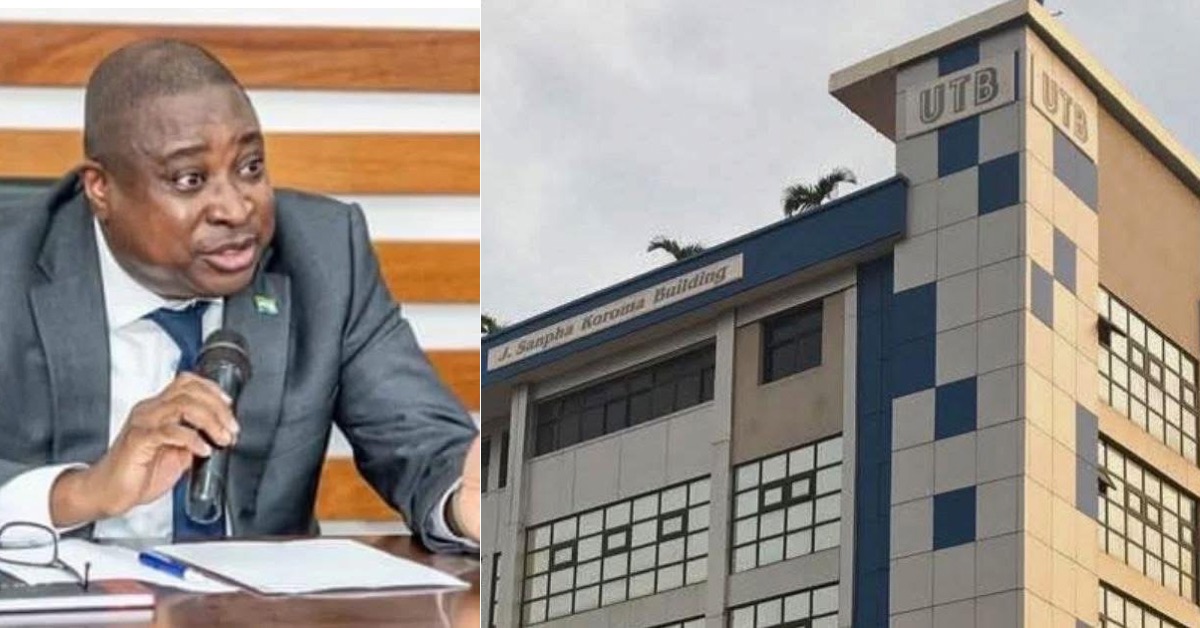
 The Bank of Sierra Leone (BSL) has disclosed alarming details surrounding the collapse and subsequent liquidation of Union Trust Bank (UTB), revealing that the indigenous financial institution had been struggling with severe financial challenges for several years before regulatory intervention became inevitable.
The revelations were made during a press conference held at the Central Bank’s headquarters in Freetown last week, where senior officials outlined the circumstances that led to the takeover of the bank earlier this year.
Speaking at the briefing, Central Bank Governor, Ibrahim Stevens, disclosed that UTB had failed to meet the minimum prudential requirements stipulated under Sierra Leone’s banking regulations. According to him, the bank recorded only Le33.82 million in paid-up capital against accumulated retained losses amounting to Le328.52 million, resulting in a substantial negative capital position.

Governor Stevens explained that the financial condition of the bank had rendered it insolvent, making it incapable of satisfying the minimum capital requirements prescribed under the Banking Act of 2019.
He further warned that the institution’s available resources were insufficient to withstand a large-scale withdrawal of deposits, noting that UTB would have struggled to honour its obligations had depositors simultaneously sought to access their funds.
“The bank was insolvent and unable to meet the minimum capital requirements under the Banking Act,” Stevens stated, adding that protecting depositors and maintaining financial system stability remained the Central Bank’s foremost priority.
The Bank of Sierra Leone also revealed that UTB’s financial difficulties were not recent developments but had persisted for several years.
Deputy Governor for Financial Stability, Alfred Samah, disclosed that the bank had consistently failed to meet regulatory capital requirements since 2018. In response to the deteriorating financial condition, the Central Bank placed UTB under Enhanced Supervision in September 2020 and assigned a Resident Examiner to closely monitor its operations.
According to Samah, the enhanced supervisory measures were intended to improve the bank’s governance structure, strengthen risk management systems, and implement strategies aimed at restoring profitability and long-term sustainability.
Despite these interventions, however, UTB was unable to regain financial stability.
The Central Bank stated that extensive efforts were made over the years to rescue the institution, including attempts to attract private investors and strategic partners capable of recapitalising the bank. Authorities disclosed that these efforts failed to yield results, with potential investors, corporate entities, and even international financial institutions declining to provide the capital injection needed to restore the bank’s viability.
As the situation continued to worsen, the Bank of Sierra Leone placed UTB under resolution in December last year for a period of six months, in accordance with provisions of the Banking Act of 2019.
A Caretaker Management Team was subsequently appointed to oversee the transition process, while audit and advisory firm Kreston was engaged as a facilitator to support the transfer process and manage the recovery of underperforming assets.
Union Trust Bank operated in Sierra Leone for more than 25 years and held a unique position in the country’s banking sector as the only indigenous-owned commercial bank. The institution was founded by the late former Central Bank Governor, Sanpha Koroma, and was widely regarded as a symbol of local participation in the nation’s financial industry.
While the Bank of Sierra Leone has maintained that its actions were guided by legal and regulatory requirements and undertaken in good faith to safeguard the financial system, the decision has not been without controversy.
The former Executive Director of UTB, Wusu Bai Koroma expressed dissatisfaction with the process, arguing that the bank and its leadership were not treated fairly during the regulatory intervention. Koroma questioned aspects of the takeover and liquidation process.
Meanwhile, reports indicate that Rokel Commercial Bank is expected to assume the operations of Union Trust Bank as part of ongoing efforts to ensure continuity of banking services and protect customer interests.
The liquidation of UTB marks a major development in Sierra Leone’s banking sector and brings an end to the operations of a financial institution that served customers across the country for over two decades. Financial analysts say the move highlights the growing emphasis being placed on regulatory compliance, capital adequacy, and financial stability within the country’s banking industry.