

“Governing a Poor Country”: A Citizen’s Review of Prof. David Francis’ Book
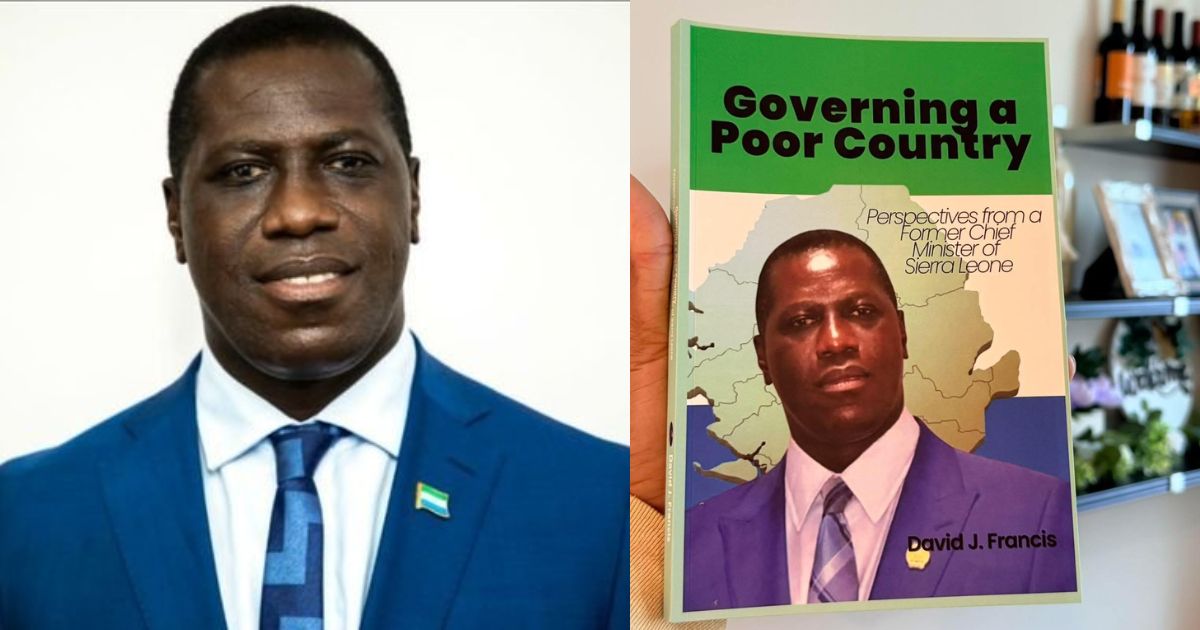
Sometime in April, I received an unsolicited, autographed copy of Prof. David Francis’ newly published book, Governing a Poor Country. My reaction was a blend of consternation and delight—consternation at the unexpectedness of the gesture, and delight at what I can only describe as intellectual almsgiving. In West Africa, one who gives kolanut is revered as a life-giver; for me, anyone who gifts a book is a giver of knowledge. I did commit on social media to reviewing the book in honour of the gesture. And so, a month later, aboard an ASKY aircraft some 30,000 feet above sea level, I found myself devouring its contents.
Before opening the cover, I carried many prejudices—understandably so. As a youth activist turned pro-democracy campaigner with two decades of experience enduring the consequences of bad governance, I am naturally sceptical of political leaders who preach governance principles that contradict their own leadership records. Writing a book on governance while governance excesses stare us in the face—under a regime in which the author served—felt, at first glance, like a mockery of our collective suffering. It felt akin to someone who has never attained a millionaire status writing a manual on how to become one. Or perhaps it fits the familiar adage: Do as I say, but not as I do. It felt uncanny.
Neo‑patrimonialism: A Political Architecture Designed to Fail
To my surprise, many of my prejudices began to melt away as I encountered the author’s uncharacteristic admissions of his ruling party’s mistakes, misjudgements, divisive rhetoric and his own lack of appreciation for political nuances. Like Prof. Francis, I have long held the view that a country so “fantastically rich and natural‑resource endowed” should not be so spectacularly poor.

The author does not sugarcoat our political malaise. He identifies patron‑client politics—our entrenched neo‑patrimonial order—as the central architecture of our nation’s failings:



“This type of prebendal politics creates an informal system of governance that informalises and privatises all the state governing institutions to serve the vested interests of those in power…” (p. 21)
This is an honest diagnosis. Our politics of patronage, patrimony, and prebendalism is indeed the foundation of our crisis. Yet this makes the author’s earlier public defence of “one percent corruption” as an acceptable margin even more paradoxical. How does one decry prebendalism in theory while justifying its practice through a one-percentile-acceptable-margin for corruption? Besides, who measures such quantum? It beggars belief.
Leadership as the Primary Culprit
Where the author and I converge most strongly is on leadership. Prof. Francis writes:
“The scourge of leadership failure has been the bane of Sierra Leone’s underdevelopment…” (p. 134)
His call for competent, disciplined, people‑centred leadership to avoid another fifty years of stagnation reads almost like a muted admission that the administration he served in did not attain these thresholds. Whether this is an indictment of his former boss or an act of intellectual penance is open to interpretation. What is clear is that he places the blame squarely on leadership—not the people.
For years, I have argued that visionary leadership is the missing ingredient in our national transformation. Prof. Francis’ reflections reinforce this personal conviction.
A Book Heavy on Self‑Adulation
My general impression, however, is that the book is heavy on self‑praise. The author generously attributes to himself decorum, professionalism, discipline, and competence:
“There is national consensus… that I brought decorum, respectability, professionalism, discipline, strong and assertive leadership and competence to governance.” (p. 44)
Self-evaluation is not inherently wrong, but this level of self-adulation—unsupported by independent assessment—feels overstated. It also overshadows opportunities for deeper introspection. The principle that one should not be a judge in their own cause applies in academia as much as it does in law.
For instance, the author suggests that substantially a SierraEye billboard quoting the late Dr. Abdulai Conteh’s article “President Bio Leading But Not in Charge?” sowed seeds of distrust that led to his dismissal. This feels speculative at best. But more importantly, he does not interrogate his own role in the political dynamics that led to his exit.
Conclusion
Prof. Francis may not fit the mould of a quintessential politician, but his academic grasp of governance is undeniable. Governance has its theorists and practitioners; he appears more suited to the former category. While I personally do not see any necessity for the office of Chief Minister, I agree with the author that, if it must exist, it should be occupied by technocrats—not political aspirants with “vaulting ambition”.
One of the most commendable aspects of the book is the author’s remorse over the inflammatory language used in the 2018 GTT Report:
“With the benefit of hindsight… I would never have used such colourful and divisive language…” (pp. 122–123)
Such contrition is healthy. Admissions of error, misjudgement, and poor leadership decisions help cultivate public trust and remind citizens that leaders, too, are fallible.
In the end, Governing a Poor Country is a curious blend of candour and self-congratulation, theory and contradiction, insight and blind spots. Yet it contributes meaningfully to the discourse on governance in Sierra Leone—and for that, it deserves an unbiased readership.
O God help Sierra Leone. Other countries leaders transform their people from poverty to better living conditions. And we morelessed them