

Labour Ministry Begins Workshop on Ratifying Key International Labour Conventions
 Osman Tolo Sesay
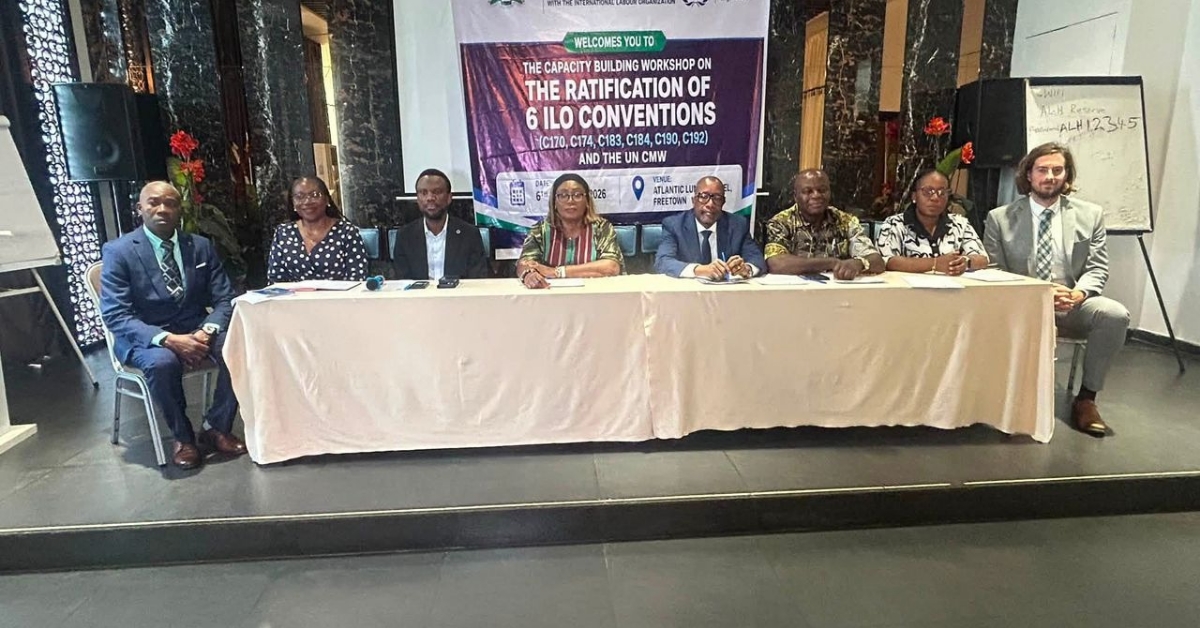
 The Ministry of Employment, Labour and Social Security has launched a three-day capacity-building workshop in Freetown to prepare Sierra Leone for the ratification of six priority International Labour Organization (ILO) conventions and the United Nations Convention on the Protection of the Rights of All Migrant Workers and Members of Their Families.
The workshop, which runs from 6 to 8 July 2026, is being organized in collaboration with the International Labour Organization (ILO) as part of ongoing efforts to strengthen Sierra Leone’s labour governance framework and align national labour laws with international standards.
Speaking at the opening ceremony, Minister of Employment, Labour and Social Security, Hon. Mohamed Rahman Swaray, described the workshop as a major step in the Government’s labour reform agenda.

He said the initiative demonstrates Sierra Leone’s commitment to promoting decent work, improving labour standards and supporting the objectives of the Medium-Term National Development Plan (2024–2030) and Sustainable Development Goal 8 on decent work and economic growth.


The Minister stated that Sierra Leone has ratified 45 ILO conventions since becoming a member of the organization in 1961, including all ten fundamental conventions, two governance conventions and 33 technical conventions. He noted that 32 of these conventions remain in force, while four have been denounced and nine have been abrogated.
According to him, the conventions currently under consideration address key areas including occupational safety and health, maternity protection, workplace violence and harassment, chemical safety, biological hazards and the protection of migrant workers.
He said their ratification will further strengthen the country’s labour laws, improve workplace conditions, increase productivity and reinforce Sierra Leone’s commitment to international labour standards.
Minister Swaray emphasized that ratifying the conventions must be followed by effective domestication, implementation, monitoring and continuous social dialogue to ensure the intended benefits are realized.
He also announced that the Ministry, in partnership with the ILO, will convene the Decent Work Country Programme Committee meeting from 9 to 11 July 2026 to review progress, address implementation challenges, strengthen tripartite cooperation and identify priority actions for advancing decent work in Sierra Leone.
Representing the ILO Country Director, Chinyere Emeka-Anuna commended the Government of Sierra Leone for its commitment to promoting international labour standards and social justice.
She said the workshop is examining Convention No. 170 on Chemicals, Convention No. 174 on the Prevention of Major Industrial Accidents, Convention No. 184 on Safety and Health in Agriculture, Convention No. 183 on Maternity Protection, Convention No. 190 on Violence and Harassment in the World of Work, Convention No. 192 on Biological Hazards in the Working Environment, as well as the UN Convention on the Protection of the Rights of All Migrant Workers and Members of Their Families.
She noted that Conventions 183 and 190 have particular significance in strengthening gender equality, enhancing maternity protection, preventing workplace violence and promoting safer and more inclusive working environments.
Representatives of employers and workers also welcomed the initiative. Project Officer of the Sierra Leone Employers’ Federation, Yvette Kargbo, said the proposed conventions would contribute to safer workplaces, higher productivity and stronger business resilience, while calling for implementation measures that consider the realities of micro, small and medium-sized enterprises.
Secretary-General of the Sierra Leone Labour Congress, Marx Conteh, described the workshop as timely and urged the Government to expedite the passage of outstanding labour legislation to complete the country’s ongoing labour law reforms.
The workshop has brought together government officials, employers’ and workers’ organizations, development partners and labour experts to build consensus on the proposed ratifications and support the continued modernization of Sierra Leone’s labour sector.