Sierra Leone Records Increase in Rice Production, Hits 73% Self-Sufficiency
 Kanja Sesay
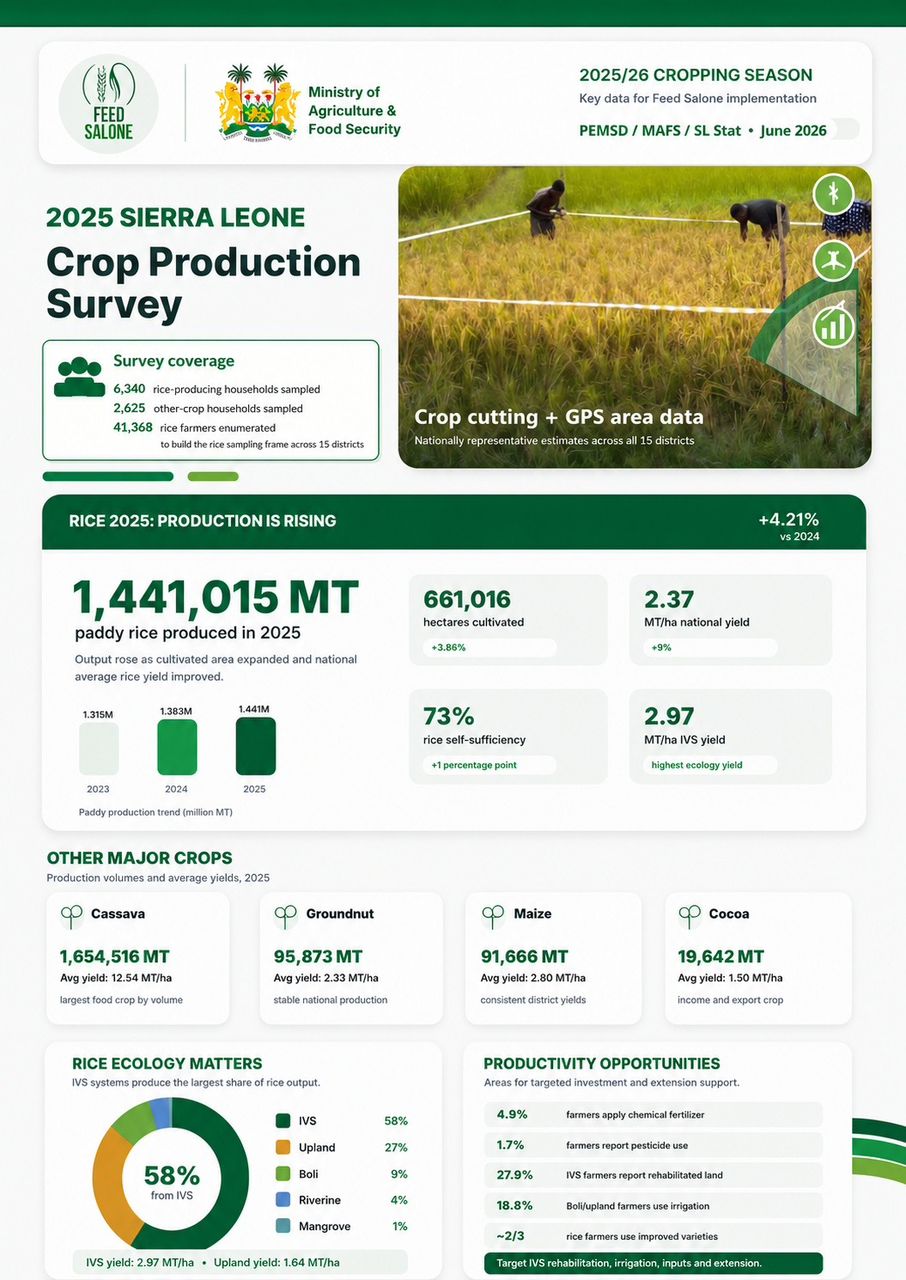
 Sierra Leone’s rice production increased by 4.2% in 2025, with the country producing over 1.4 million metric tonnes of paddy rice and reaching 73% rice self-sufficiency, according to the latest Crop Production Survey released by the Ministry of Agriculture and Food Security.
The 2025 Sierra Leone Crop Production Survey, conducted by the Planning, Evaluation, Monitoring and Statistics Division (PEMSD) of the Ministry of Agriculture and Food Security, in collaboration with Statistics Sierra Leone, shows that the country produced 1,441,015 metric tonnes of paddy rice in 2025.
The report indicates that rice production has continued to grow over the past three years, rising from 1.315 million metric tonnes in 2023 to 1.383 million metric tonnes in 2024, before reaching the current figure.

The increase was linked to both expanded farming areas and improved productivity. According to the survey, farmers cultivated 661,016 hectares of rice in 2025, representing a 3.86% increase from the previous year, while average national yield increased by 9% to 2.37 metric tonnes per hectare.


The survey covered all 15 districts of Sierra Leone and involved 6,340 rice-producing households, 2,625 other-crop households, and 41,368 farmers using crop-cutting methods and GPS area measurements.
The report identified Inland Valley Swamp (IVS) farming systems as the leading contributor to rice production, accounting for 58% of national output. IVS farms recorded the highest average yield at 2.97 metric tonnes per hectare, compared to 1.64 metric tonnes per hectare for upland farms.
Upland farming contributed 27% of total rice production, while Boli accounted for 9%, Riverine 4%, and Mangrove 1%.
The Ministry highlighted IVS rehabilitation, irrigation development, agricultural inputs, and extension services as key areas requiring further investment to improve productivity.
Beyond rice, the survey also highlighted the performance of other major crops. Cassava remained the largest food crop by production volume, with 1,654,516 metric tonnes produced at an average yield of 12.54 metric tonnes per hectare.
Other crops recorded in the survey include groundnut with 95,873 metric tonnes, maize with 91,666 metric tonnes, and cocoa with 19,642 metric tonnes, which the report identified as an important income and export crop.
However, the survey also revealed challenges affecting agricultural productivity, including low use of farming inputs. It showed that only 4.9% of farmers use chemical fertilizer, while 1.7% reported pesticide use. About two-thirds of rice farmers use improved varieties.
The report also noted limited access to irrigation, with only 18.8% of Boli and upland farmers using irrigation, while 27.9% of IVS farmers reported having rehabilitated land.
At 73% rice self-sufficiency, Sierra Leone is making progress towards reducing dependence on imported rice, a key objective of the government’s Feed Salone programme.
The Ministry of Agriculture and Food Security said the 2025/26 farming season will focus on expanding Inland Valley Swamp development and increasing support for upland farmers to further improve food production.